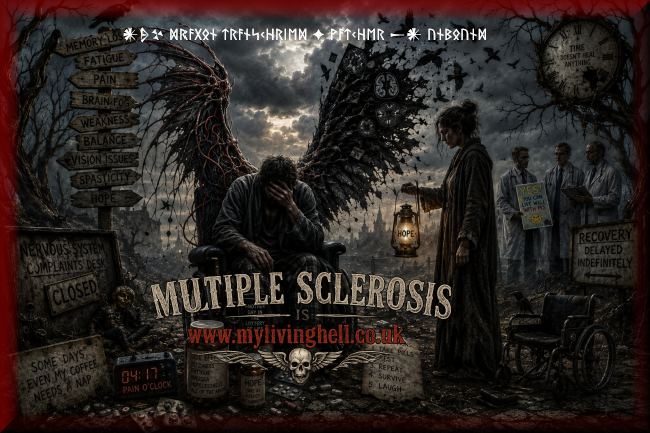
Multiple sclerosis is My Living Hell

MS symptoms

All posts tagged MS symptoms by Multiple sclerosis is My Living Hell
  • Posted on

    ⚠️ This blog shares my personal, sometimes painful experiences with MS and mental health. My intention is to speak honestly and offer solidarity—not to harm or replace professional advice. I’m not a doctor or therapist, just someone who gets how hard it can get. If you’re struggling, you’re not alone. Please reach out to a trusted friend, support group, or professional. You deserve help and hope.⚠️

    please remember I suffer with severe cognitive dysfunction, and use AI to proof read and help solve this issue so you can understand it

    "The Different Types of MS: Relapsing-Remitting, Primary Progressive, and More"

    (Or, "How to Lose at Life While Losing Your Nervous System")

    Introduction: Welcome to the MS Lottery

    Congratulations! You’ve just won a lifetime supply of neurological chaos, served with a side of uncertainty. Multiple sclerosis (MS) isn’t one-size-fits-all—it’s more like a choose-your-own-adventure book where every path leads to "I hope this isn’t me."

    Whether you’re here because you’ve just been diagnosed, you know someone who has it, or you’re just morbidly curious about how the brain can betray you, this is your no-BS guide to the different types of MS. Spoiler alert: None of them are fun.

    1. Relapsing-Remitting MS (RRMS)

    The "On Again, Off Again" Special (Affects ~85% of people at diagnosis—lucky you!)

    What It Is:

    You get symptom flare-ups (relapses) that come out of nowhere, followed by periods where you pretend nothing happened (remissions). It’s like your brain is playing a game of "Hot Potato: Nervous System Edition."

    Key Features

    ✔ Relapses: New or worsening symptoms (numbness, vision problems, fatigue—classic MS moves).

    ✔ Remissions: Symptoms improve partially or completely. Congrats! You’re back to normal… for now.

    ✔ Early symptoms: Optic neuritis (your eye decides to go rogue), tingling in your limbs, balance issues.

    Progression Over Time:

    Some people stay stable for years (lucky bastards). Others transition to Secondary Progressive MS (SPMS), where things start getting less fun. Visual Idea: A graph showing relapse-remission cycles with the caption "Your brain’s way of saying ‘I’m still here, but barely.’"

    2. Secondary Progressive MS (SPMS)

    The "Slow Burn" Edition (Affects ~69% of PwMS within 25 years—because why not?)

    What It Is:

    You start as RRMS, but then your brain decides "Screw it, I’m doing this the hard way." Symptoms worsen steadily, and remissions become a distant memory.

    Key Features:

    ✔ No more full recoveries. Relapses might still happen, but they don’t go away.

    ✔ Symptoms accumulate like a debt you can’t pay off.

    ✔ Common later-stage symptoms: Mobility issues (walking becomes a metaphorical and literal challenge), cognitive decline, bladder/bowel problems.

    "From ‘I can still walk’ to ‘Please help me.’"

    3. Primary Progressive MS (PPMS)

    The "No Breaks, Just Suffering" Track (Affects ~10–15% of PwMS—because variety is the spice of life.)

    What It Is:

    You get progressive disability from the start, with no relapses or remissions. It’s like your brain is on a one-way ticket to "I can’t do that anymore."

    Key Features:

    ✔ No early relapses—just steady decline.

    ✔ Common symptoms: Spasticity (your muscles decide they hate you), fatigue (because why not?), cognitive changes.

    ✔ Slower progression than SPMS, but still a slow-motion disaster.

    4. Clinically Isolated Syndrome (CIS)

    The "Maybe It’s MS, Maybe Not" Phase (Early-stage MS or a one-time episode—because life loves uncertainty.)

    What It Is:

    You have one neurological symptom that could be MS but isn’t yet confirmed. It’s like your brain is flirting with the idea of betraying you.

    Key Features:

    ✔ Single relapse, no prior MS diagnosis.

    ✔ MRI may show lesions (plaques) in your brain or spinal cord.

    5. Radiologically Isolated Syndrome (RIS)

    The "My Brain Has Lesions, But I’m Fine" Phase (Preclinical MS—because why not start early?)

    What It Is:

    You have MS-like lesions on MRI but no symptoms yet. It’s like your brain is quietly sabotaging itself behind the scenes.

    Key Features:

    ✔ No neurological symptoms (yet).

    ✔ Monitored closely for progression.

    6. Other Rare Forms Because MS Loves Variety

    Relapsing-Progressive MS (RPMS): Relapses + steady worsening (the worst of both worlds). Progressive-Relapsing MS (PRMS): Rare, but if you get this, congrats, you’re a unicorn. How Is MS Diagnosed? (Spoiler: It’s a Pain) (Briefly cover diagnostic criteria—McDonald’s Criteria, MRI, spinal fluid tests, etc.)

    What Does This Mean for Treatment?

    (Spoiler: It’s a Work in Progress)

    RRMS & SPMS: Often treated with disease-modifying therapies (DMTs)—because why not try to slow things down? PPMS: Some DMTs are approved specifically for PPMS (hope springs eternal). CIS/RIS: Monitored closely, but some may start treatment early if they’re high-risk. Visual Idea: A table comparing treatment options with the caption "Your brain’s ‘I’ll try to behave’ phase."

    Living with Different Types of MS

    (Or, "How to Not Lose Your Mind")

    For RRMS: Manage relapses (steroids are your friend). Track symptoms between flare-ups (because denial is a river in Egypt). For PPMS/SPMS: Adaptive strategies for mobility/cognition (because walking is overrated). Emotional support (because losing your ability to walk is hard). "I used to walk, now I’m a human wheelchair—thanks, MS."

    Key Takeaways

    (Or, "Things You’ll Learn the Hard Way")

    MS isn’t one-size-fits-all—it’s more like a buffet of suffering. Early diagnosis is crucial, even if you’re asymptomatic (yet). Treatment options vary, so work closely with your neurologist (or cry into their shoulder). Support groups and advocacy can help you navigate this mess.

    Final Thought:

    Dark Humour is a Coping Mechanism MS is a real, debilitating condition, but laughing about it helps. Whether you’re dealing with relapses, progressive disability, or just the daily grind of living with a chronic illness, you’re not alone.

    peace healing love and light to all the readers of this blog

    Warlock Dark Chronic illness survivor, truth-teller, occasional bastard. From My Living Hell (For those who came here by accident: yes, my living hell is real. And yes, we still fight. Every shitty day. With defiance.)
    ☣ This Is Not A Blog About MS This Is My Life With MS ☣
    twitter@goblinbloggeruk - sick@mylivinghell.co.uk
    enter image description here

  • Posted on

    ⚠️ This blog shares my personal, sometimes painful experiences with MS and mental health. My intention is to speak honestly and offer solidarity—not to harm or replace professional advice. I’m not a doctor or therapist, just someone who gets how hard it can get. If you’re struggling, you’re not alone. Please reach out to a trusted friend, support group, or professional. You deserve help and hope.⚠️

    please remember I suffer with severe cognitive dysfunction, and use AI to proof read and help solve this issue so you can understand it

    A raw, darkly funny and unapologetically personal take on living with Multiple Sclerosis. Symptoms, fatigue, mobility, brain fog and the absurdity of everyday MS life.

    Chapter One: Congratulations, You've Been Promoted to Professional Liability

    Welcome to the blog.

    If you're reading this, chances are you've either been diagnosed with Multiple Sclerosis, know somebody who has, or you've accidentally wandered in while looking for recipes.

    If it's the latter, the Yorkshire pudding recipe is in another universe.

    For the rest of us...

    Welcome to the club that nobody wanted to join.

    Membership benefits include:

    • Randomly falling over for no obvious reason.
    • Forgetting what you walked into a room for.
    • Being permanently exhausted despite achieving absolutely nothing.
    • Discovering that your own immune system has become your full-time stalker.

    There are no loyalty points.

    There is, however, a lifetime supply of unsolicited advice.


    Rule Number One

    The first thing you'll discover is that everyone suddenly becomes a neurologist.

    Your neighbour recommends turmeric.

    Your aunt swears by celery juice.

    Some bloke on Facebook says crystals cured his cousin's hamster, so clearly they'll repair your spinal cord.

    Smile politely.

    Then continue taking the medication invented by people who actually went to medical school.


    Rule Number Two

    Never Waste Good Symptoms

    MS is incredibly creative.

    One day your leg works.

    The next day it's merely decorative.

    Sometimes your hand forgets it's attached to you.

    Occasionally your tongue joins a witness protection programme.

    Enjoy the mystery.

    It's like opening an advent calendar designed by Satan.

    You never know what's behind today's little door.


    Rule Number Three

    Accept That Your Brain Runs on Rural Broadband

    People ask...

    "What's wrong?"

    Nothing.

    I'm simply waiting for Windows 98 to finish loading.

    My thoughts are arriving one packet at a time.

    Estimated completion...

    Three to five working days.


    Rule Number Four

    Master the Ancient Art of Looking Fine

    You'll hear this sentence approximately 47,000 times.

    "But you look so well!"

    Thank you.

    You also look like someone who hasn't just fought their own nervous system before breakfast.

    Appearances can be deceptive.

    Like politicians.

    Or supermarket sandwiches.


    Rule Number Five

    Become One With Furniture

    Experienced MS sufferers know every bench within a five-mile radius.

    You don't choose routes by scenery.

    You choose them by available seating.

    That suspicious-looking wall outside the chemist?

    Luxury.


    Rule Number Six

    Your Mobility Scooter is Now a Mythical Beast

    This isn't a mobility scooter.

    It's a steel horse.

    A dragon with indicators.

    A noble mechanical steed that bravely carries you into battle...

    ...at a legally restricted 8 mph.

    The Hells Angels nod respectfully.

    Mostly because you've blocked the pavement.


    Rule Number Seven

    Never Trust a Good Day

    A good day is wonderful.

    It is also suspicious.

    Don't ask questions.

    Simply enjoy it while your nervous system isn't paying attention.

    Tomorrow it may remember you're having fun.


    Final Advice

    People often apologise because they don't know what to say.

    Don't worry.

    Neither do we.

    We forget halfway through the sentence anyway.

    If there's one thing MS teaches you, it's that life doesn't always make sense.

    So laugh anyway.

    Laugh because the disease hates it.

    Laugh because the alternative is giving it all the best lines.

    And if your legs refuse to cooperate...

    At least your sense of humour still knows where it's going.

    Probably.

    wishing everyone peace healing love and light

    Warlock Dark Chronic illness survivor, truth-teller, occasional bastard. From My Living Hell (For those who came here by accident: yes, my living hell is real. And yes, we still fight. Every shitty day. With defiance.)
    ☣ This Is Not A Blog About MS This Is My Life With MS ☣

    twitter@goblinbloggeruk - sick@mylivinghell.co.uk
    enter image description here

  • Posted on

    ⚠️ This blog shares my personal, sometimes painful experiences with MS and mental health. My intention is to speak honestly and offer solidarity—not to harm or replace professional advice. I’m not a doctor or therapist, just someone who gets how hard it can get. If you’re struggling, you’re not alone. Please reach out to a trusted friend, support group, or professional. You deserve help and hope.⚠️

    please remember I suffer with severe cognitive dysfunction, and use AI to proof read and help solve this issue so you can understand it

    well as I post this I am suffering with a stress attack with brain fog,and my autonomic dysfunction is strangling me making it harder to breathe looking like the nxt few days are going to be a bit unpleasant.. still remember to hydrate and not to over do things like I have and am really paying for it now due to me not taking my own advice still things have to be done until I cant any more physically and mentally as I slide deeper into this progressive ms but that’s life

    Because apparently losing control of your nervous system wasn’t humiliating enough

    Multiple Sclerosis is many things.

    It is painful. Exhausting. Frustrating. Unpredictable. Occasionally terrifying.

    It is also, and nobody puts this bit on the cheerful NHS leaflet, spectacularly fucking embarrassing.

    MS doesn't merely attack your nervous system. Oh no. That would be far too straightforward.

    It waits.

    It studies you.

    It learns precisely which remaining scrap of dignity you still possess...

    ...and then kicks it down a flight of stairs while you piss yourself trying to remember what a staircase is called.

    Welcome to another glamorous day with Multiple Sclerosis.

    Here are 20 of the most embarrassing things MS can throw at you.

    And before somebody sends me a strongly worded email: yes, these things are serious. Bladder dysfunction, bowel problems, cognitive impairment, tremor, mobility problems and spasms can have a massive effect on somebody's life.

    Sometimes laughing at the bastard is how we survive it.

    1. The Emergency Toilet Sprint

    Your bladder sends an urgent neurological telegram:

    TOILET. NOW.

    Unfortunately, your legs received a completely different message:

    We’ll get back to you within three to five working days.

    So begins the world's slowest emergency sprint.

    You can see the toilet.

    The toilet can see you.

    There are twelve feet between you.

    It may as well be fucking Everest.

    2. Pissing Yourself in Public

    There isn't really an elegant way of describing this one.

    Sometimes MS means you don't make it.

    You can plan routes around toilets, restrict drinks, wear protection, know every accessible loo within a twenty-mile radius and still occasionally discover that your bladder has declared itself an independent republic.

    And nothing restores your dignity quite like standing in public thinking:

    Well. That's wet.

    3. The Fart of Uncertain Intentions

    For most people, passing wind is a fairly straightforward administrative procedure.

    With dodgy sensation and bowel problems, however, every fart becomes a high-stakes negotiation.

    You think:

    "Probably safe."

    Your bowel replies:

    "Interesting theory."

    And suddenly you're gambling with odds that would get a casino investigated.

    Never trust a fart when your nervous system is being operated by drunk electricians.

    4. Walking Like You've Drunk Twelve Pints While Completely Sober

    There you are at ten o'clock in the morning, staggering down the pavement like you've spent the night drinking industrial quantities of whisky.

    You haven't.

    You're completely sober.

    Your balance just happens to resemble that of a pirate walking across a trampoline during an earthquake.

    The looks from strangers are particularly charming.

    You sometimes want a T-shirt saying:

    I'M NOT PISSED. MY BRAIN HAS JUST LOST CONTACT WITH MY LEGS.

    5. Falling Over Absolutely Nothing

    No ice.

    No kerb.

    No loose paving slab.

    No small child with a tripwire.

    Nothing.

    One second you're standing upright.

    The next you're examining the carpet at extremely close range.

    Someone inevitably asks:

    "What did you trip over?"

    My central nervous system, apparently.

    6. The Wall Bounce

    Why simply walk through a doorway when you can enter it like a pinball?

    Left shoulder.

    Right shoulder.

    Door frame.

    Cupboard.

    Possibly the dog.

    Eventually you arrive in the next room looking as though you've just escaped a pub fight.

    Technically, you successfully walked ten feet.

    Achievement unlocked.

    7. Missing the Chair

    You have been sitting down successfully for most of your life.

    It isn't a new skill.

    You understand the basic concept.

    Chair behind bottom.

    Bottom goes down.

    Civilisation has relied upon this technology for centuries.

    Then MS gets involved.

    Suddenly sitting down requires trajectory calculations normally performed by NASA.

    And occasionally...

    you miss.

    8. Dropping Absolutely Everything

    Phone.

    Keys.

    Fork.

    Remote.

    Cup.

    Pen.

    Medication.

    The thing you've just spent twenty minutes looking for.

    There comes a point where you stop picking things up immediately because experience has taught you that you'll probably drop the bastard again.

    Eventually the floor becomes a secondary storage system.

    9. The Fork-to-Mouth Navigation Failure

    The objective is simple:

    Move food approximately twelve inches from plate to mouth.

    Unfortunately your nervous system has decided this requires experimental choreography.

    Food goes onto your shirt.

    Onto your cheek.

    Onto the table.

    Possibly into your hair.

    Your mouth sits patiently nearby wondering why nobody invited it.

    Fine dining with MS.

    Michelin would be appalled.

    10. The Brain-Fog Conversation Crash

    You are halfway through a perfectly intelligent sentence.

    You know exactly what you're talking about.

    Then...

    Nothing.

    The thought has vanished.

    Not hidden.

    Not temporarily misplaced.

    Deleted.

    The other person waits.

    You wait.

    Your brain displays the neurological equivalent of:

    404 — THOUGHT NOT FOUND

    Eventually you say:

    "I've forgotten what I was saying."

    They helpfully reply:

    "You were talking about—"

    YES, THANK YOU, I KNOW I WAS TALKING.

    THAT'S THE PROBLEM.

    11. Forgetting the Name of Someone You've Known for Twenty Years

    You recognise their face.

    You know where they live.

    You know their partner.

    You've been to their wedding.

    You may even know their dog's birthday.

    Their name?

    Gone.

    So suddenly everybody becomes:

    "Mate."

    "Love."

    "Hello... you."

    Nothing suspicious about that whatsoever.

    12. Using Completely the Wrong Word

    "Pass me the... food shovel."

    "The what?"

    "The silver thing."

    "A spoon?"

    "YES. THE FUCKING SPOON."

    Brain fog doesn't necessarily remove the concept.

    Sometimes it merely removes the perfectly ordinary word describing it.

    So your house becomes filled with exciting new objects such as:

    The clothes washing box.

    The cold cupboard.

    The television changer.

    The foot gloves.

    And the thingy.

    Especially the thingy.

    13. The Leg That Resigns Without Notice

    Everything is going surprisingly well.

    Left leg working.

    Right leg working.

    Walking happening.

    Excellent.

    Then one leg suddenly announces:

    I no longer recognise the authority of the brain.

    It drags.

    It buckles.

    It stops.

    Or it wanders somewhere you hadn't intended.

    Apparently collective bargaining has reached the spinal cord.

    14. Getting Trapped in Your Own Clothes

    Putting trousers on should not require strategic planning.

    But when balance, weakness, stiffness or coordination are having a bad day, getting dressed becomes an escape room in reverse.

    One trouser leg twists.

    Your foot disappears.

    You lose your balance.

    Now you're hopping.

    Hopping was a mistake.

    Eventually you're lying sideways on the bed wearing one sock and quietly threatening a pair of jeans.

    15. The Public Tremor Performance

    You are carrying a cup of coffee.

    The cup is full.

    People are watching.

    Your hand suddenly decides it has always dreamed of becoming a cocktail shaker.

    Coffee begins performing orbital manoeuvres around the rim.

    You stare at it.

    Everyone else stares at it.

    You attempt to walk very carefully.

    This naturally makes everything worse.

    By the time you sit down, you've transported approximately 40% of the coffee.

    The rest is decorating the route.

    16. Being Defeated by a Sofa

    You sat down.

    This was your first mistake.

    Twenty minutes later you decide to stand.

    Your legs disagree.

    So begins the launch procedure.

    Rock forward.

    Rock back.

    Forward.

    Back.

    Forward again.

    Hands on knees.

    Push.

    Nothing.

    Reposition.

    Make strange noise.

    Try again.

    Eventually you achieve verticality with the elegance of a newborn giraffe being fired from a trebuchet.

    17. When MS Invites Itself Into Your Sex Life

    Nobody puts this in the glossy information leaflet either.

    Numbness.

    Altered sensation.

    Spasms.

    Pain.

    Fatigue.

    Weakness.

    Bladder urgency.

    Parts of your anatomy apparently working to completely different timetables.

    Romance can occasionally become less:

    Fifty Shades of Grey

    and more:

    Could you move my leg? It's gone numb and I need a piss.

    Sexy.

    Very sexy indeed.

    18. The Sudden Spasm

    Your body suddenly jerks.

    You didn't request it.

    You didn't approve it.

    You weren't consulted.

    MS has simply activated the random movement generator.

    Naturally this often happens at precisely the moment you'd prefer to appear calm and normal.

    Your body:

    SURPRISE!


    19. The Scooter or Wheelchair Manoeuvre of Shame

    Mobility equipment gives independence.

    It can also provide opportunities for spectacular mechanical humiliation.

    Doorways become narrower.

    Shop displays become magnetic.

    Furniture develops suicidal tendencies.

    You misjudge a corner.

    Clip something.

    Reverse.

    Clip something else.

    Reverse again.

    Now six people are watching.

    At this point there is only one sensible course of action.

    Pretend the entire manoeuvre was deliberate.

    Professional driver.

    Obviously.

    20. Having to Explain Any of the Above

    And perhaps this is the final indignity.

    Something embarrassing happens.

    People stare.

    Someone asks whether you're alright.

    And you find yourself calmly explaining:

    "I've got Multiple Sclerosis."

    As though MS is some badly behaved child you've brought shopping.

    Meanwhile inside your head you're saying:

    YES, THANK YOU, NERVOUS SYSTEM.

    ANOTHER FUCKING MASTERCLASS.

    Eventually, Embarrassing Just Becomes Tuesday

    There is a peculiar point you can reach with chronic illness where the definition of embarrassing starts changing.

    You fall over.

    You laugh.

    You forget a word.

    You invent another one.

    You spill your drink.

    You clean it up.

    Your bladder betrays you.

    You deal with it.

    Not because these things aren't difficult.

    They bloody well are.

    Loss of independence is real.

    Loss of confidence is real.

    Bladder and bowel dysfunction can be devastating.

    Cognitive problems can be frightening.

    Mobility problems can fundamentally change somebody's life.

    But embarrassment depends partly upon believing your body shouldn't be doing these things.

    After living with MS long enough, you begin to understand something.

    Your body is damaged.

    Sometimes it misbehaves spectacularly.

    That isn't a moral failing.

    So eventually you stop apologising quite so much.

    You start adapting.

    You start carrying spare clothes.

    You learn where every toilet is.

    You laugh when you've called the refrigerator a cold food wardrobe.

    You swear at your legs.

    You negotiate with your bowels.

    You glare suspiciously at stairs.

    And somewhere along the way, the ridiculous becomes normal.

    Because after enough years with Multiple Sclerosis...

    “Embarrassing” gradually becomes “Tuesday.”

    Welcome to My Living Hell.

    Real life. Real MS. Real humour.

    No inspirational fucking butterflies required.

    and yes I have had many incidents like those above over the years.. remember when you go out be prepared for every eventuality sending everyone peace healing love and light

    Warlock Dark Chronic illness survivor, truth-teller, occasional bastard. From My Living Hell (For those who came here by accident: yes, my living hell is real. And yes, we still fight. Every shitty day. With defiance.)
    ☣ This Is Not A Blog About MS This Is My Life With MS ☣

    @goblinbloggeruk - sick@mylivinghell.co.uk
    enter image description here

  • Posted on

    ⚠️ This blog shares my personal, sometimes painful experiences with MS and mental health. My intention is to speak honestly and offer solidarity—not to harm or replace professional advice. I’m not a doctor or therapist, just someone who gets how hard it can get. If you’re struggling, you’re not alone. Please reach out to a trusted friend, support group, or professional. You deserve help and hope.⚠️

    ****please remember I suffer with severe cognitive dysfunction, and use AI to help solve this issue so you can understand it ****

    well a very good afternoon to all the readers of the blog, humanoids and nhi even.

    Multiple Sclerosis does not always behave in the way medical leaflets suggest. Alongside the better-known symptoms, MS can cause crushing chest sensations, phantom itching, electric shocks, burning feet, swallowing difficulties, emotional outbursts and strange reactions to heat. This article explores the weird side of MS with medical context, lived experience and the dark humour needed when your nervous system starts inventing symptoms of its own.

    Nobody Told Me MS Could Do That!

    The Strange Symptoms That Make You Question Your Own Sanity

    "Is this my MS... or have I finally lost the plot?"

    If you've lived with Multiple Sclerosis for more than about five minutes, you've probably asked yourself exactly that.

    One minute you're dealing with numbness.

    The next you're convinced your ribs are being crushed by an invisible anaconda.

    Then your feet feel as though someone has poured boiling water over them...

    ...except they haven't.

    Welcome to the wonderfully confusing world of MS.

    The disease doesn't read textbooks.

    Neither does your nervous system.

    While most people think MS simply causes weakness or difficulty walking, the reality is far stranger. Because MS attacks the brain and spinal cord, almost any neurological function can be affected, producing symptoms that sound completely unbelievable until you've experienced them yourself.

    The MS Hug

    Whoever named this symptom deserves a stern talking to.

    There is absolutely nothing affectionate about it.

    Imagine someone wrapping industrial ratchet straps around your chest and slowly tightening them.

    Some people think they're having a heart attack.

    Others feel they can't breathe.

    The good news?

    It's usually muscle spasms caused by damaged nerve pathways rather than damage to the heart or lungs.

    The bad news?

    It feels utterly convincing while it's happening.

    The Itch That Doesn't Exist

    This one drives people mad.

    Your arm itches.

    You scratch it.

    Still itches.

    Scratch harder.

    Nothing.

    Because the itch isn't coming from your skin.

    It's coming from your brain.

    Your nervous system has basically dialled the wrong number.

    No cream.

    No antihistamine.

    No amount of scratching fixes a signal that's being generated by damaged nerves.

    Electric Shocks Down Your Spine

    You bend your neck.

    ZAP!

    It feels as though someone has connected your spine to the National Grid.

    This is called Lhermitte's sign.

    It lasts only seconds...

    ...but those seconds certainly get your attention.

    Many people describe it as one of the strangest sensations they've ever experienced.

    Laughing When Nothing's Funny

    Or crying...

    ...when nothing is actually wrong.

    This is called pseudobulbar affect (PBA).

    It's one of the cruellest symptoms because people assume it's psychological.

    It isn't.

    It's neurological.

    The emotional wiring between different parts of the brain has become disrupted.

    Your emotions aren't fake.

    They're simply being expressed at the wrong time.

    My Feet Are On Fire...

    Except...

    They're freezing.

    Or numb.

    Or crawling with invisible insects.

    MS has an extraordinary ability to invent sensations that make absolutely no logical sense.

    Burning feet.

    Ice-cold legs.

    Pins and needles.

    Buzzing.

    Vibrating.

    Many people spend years trying to explain these feelings.

    The truth is...

    Sometimes there simply aren't words for damaged nerve signals.

    Suddenly You Can't Swallow Properly

    One moment you're eating lunch.

    The next your throat seems to have forgotten how swallowing works.

    It can be frightening.

    Swallowing is actually an incredibly complicated neurological process involving dozens of muscles and multiple cranial nerves.

    MS can interfere with that communication, making food seem to stick or making swallowing feel strangely difficult.

    Vision Has Its Own Sense of Humour

    Hot bath?

    Blurry vision.

    Warm day?

    Double vision.

    Hairdryer?

    Why not make the room wobble a little?

    Heat temporarily slows already damaged nerve pathways, causing existing symptoms to flare. This phenomenon—called Uhthoff's phenomenon—doesn't usually mean new damage has occurred, but it can make old symptoms briefly worse.

    The Invisible Symptoms Nobody Sees

    Perhaps the strangest symptom of all...

    Is having symptoms nobody else can see.

    Brain fog.

    Fatigue.

    Pain.

    Odd sensations.

    People glance at you and say...

    "You look really well."

    Meanwhile your nervous system is holding what can only be described as a small electrical civil war.

    Living With The Weird

    One thing I've learned is this...

    MS rarely asks permission.

    It simply invents new ways of reminding you that the brain controls almost everything.

    Sometimes it feels like an electrical fault in the universe.

    Sometimes it's terrifying.

    Sometimes it's absurd.

    And sometimes...

    All you can do is laugh, because if you don't, you'll spend your life trying to explain to people why your ribs are hugging you, your feet are on fire, your face is being electrocuted, and your throat has forgotten how swallowing works.

    MS isn't just unpredictable.

    It's the greatest practical joker your nervous system never wanted.

    Final Thoughts

    Living with Multiple Sclerosis means accepting that strange can become normal.

    Wishing everyone who reads this blog , peace healing love and light !

    Warlock Dark Chronic illness survivor, truth-teller, occasional bastard. From My Living Hell (For those who came here by accident: yes, my living hell is real. And yes, we still fight. Every shitty day. With defiance.)
    ☣ This Is Not A Blog About MS This Is My Life With MS ☣

    @goblinbloggeruk - sick@mylivinghell.co.uk
    𒀭𒊩𒆳 ᛞᚱᚨᚷᛟᚾ ᛏᚱᚨᚾᛋᚲᚺᚱᛁᛖᛞ ✦ ᚹᚨᛏᚲᚺᛖᚱ 𒀸𒀭 ᚢᚾᛒᛟᚢᚾᛞ
    enter image description here

  • Posted on

    ⚠️ This blog shares my personal, sometimes painful experiences with MS and mental health. My intention is to speak honestly and offer solidarity—not to harm or replace professional advice. I’m not a doctor or therapist, just someone who gets how hard it can get. If you’re struggling, you’re not alone. Please reach out to a trusted friend, support group, or professional. You deserve help and hope.⚠️

    please remember I suffer with severe cognitive dysfunction this may be a confusing read. AI help with content

    A very good afternoon ,evening, or morning,to all who read this blog, I know its Thursday..my spellings getting insane so need more help..my eye sights getting worse.. oh joy this day brings lol...

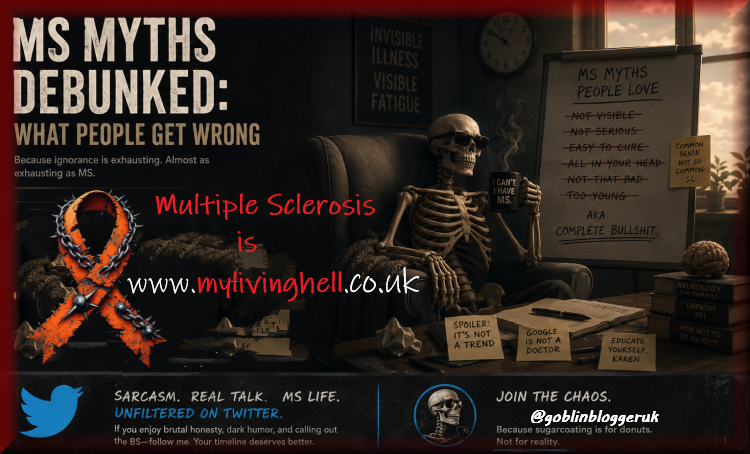
    MS Myths Debunked What People Get Wrong (And Why Google Isn't a Neurologist)

    Let's play a game.

    Take a shot every time someone says one of these classics:

    "But you don't look sick."

    "My cousin's neighbour's dog walker cured it with bonzo dog food."

    "At least it's not cancer."

    Actually... don't. Alcohol and MS fatigue are already in enough of a toxic relationship.

    If you live with Multiple Sclerosis, you've probably heard enough unsolicited medical opinions to qualify for an honorary degree in Other People's Bollocks.

    It's fascinating, really.

    You spend years dealing with neurologists, MRIs, blood tests, medications and symptoms that make absolutely no sense...

    ...then some anonymous person from social media confidently informs you that all you really need is turmeric.

    Remarkable.

    Myth #1: "You Don't Look Sick."

    Brilliant observation.

    You also don't look like you have Wi-Fi, anxiety or a mortgage, yet somehow all three exist.

    MS is often called an invisible illness because many symptoms can't be seen.

    Fatigue. Pain. Brain fog. Balance problems. Numbness. Vision issues.

    They're all real whether they come with flashing neon signs or not.

    Just because someone smiled today doesn't mean they aren't paying for it tomorrow.

    Human beings aren't mood rings.

    Myth #2: "You're Too Young To Have MS."

    MS doesn't politely wait until retirement.

    Many people are diagnosed between the ages of 20 and 40.

    Apparently autoimmune diseases never received the memo about age restrictions.

    If they had, neurologists would have considerably less paperwork.

    Myth #3: "Have You Tried..."

    Yes.

    I've tried medication.

    Physiotherapy.

    Exercise.

    Rest.

    Diet changes.

    Supplements.

    Yoga.

    Stretching.

    Hope.

    Denial.

    Swearing creatively.

    I've even tried pretending everything's fine.

    Spoiler:

    That one lasted until Tuesday.

    The internet has convinced an alarming number of people that watching three YouTube videos somehow outranks years of neurological research.

    Congratulations.

    You've mistaken confidence for competence.

    Myth #4: "It's All In Your Head."

    Technically...

    Yes.

    That's literally where the lesions are.

    Congratulations on accidentally stumbling into medical accuracy.

    Unfortunately, that's where your expertise ends.

    MS is a disease where the immune system attacks the protective covering around nerves, disrupting communication between the brain and the rest of the body.

    It's neurological.

    Not imaginary.

    There's a rather significant difference.

    Myth #5: "My Friend Has MS And They're Fine."

    Excellent.

    My mate owns a Labrador.

    That doesn't mean every dog behaves the same.

    MS is famously unpredictable.

    No two people experience it the same way.

    Some have relapsing symptoms.

    Others experience gradual progression.

    Some use mobility aids.

    Some don't.

    Some work full-time.

    Some can't.

    Comparing one person with MS to another is about as scientific as comparing apples to traffic cones.

    Myth #6: "You're Just Tired."

    No.

    You're tired.

    I'm experiencing fatigue.

    There's a difference.

    Being tired is needing another coffee.

    MS fatigue is feeling like someone unplugged your batteries, replaced your bones with wet cement and then expected you to function like nothing happened.

    It's not laziness.

    It's not lack of motivation.

    It's one of the most disabling symptoms many people with MS experience.

    Myth #7: "There's Probably A Cure They're Hiding."

    Ah yes.

    The secret underground vault where scientists keep cures next to Bigfoot, Atlantis and common sense on social media.

    Medical research is improving all the time.

    Treatments have advanced enormously.

    Many people now live fuller, longer lives because of disease-modifying therapies.

    But there isn't a miracle cure hidden behind a curtain while neurologists twirl moustaches and laugh maniacally.

    Real science isn't a Netflix conspiracy documentary.

    It's slower.

    Messier.

    And considerably less exciting.

    The Real Problem

    The biggest disability many people with MS face isn't always the disease.

    Sometimes it's ignorance dressed up as kindness.

    People mean well.

    Mostly.

    But good intentions don't magically become useful information.

    Sometimes the most helpful thing you can say is astonishingly simple.

    "I'm sorry you're dealing with that."

    "How are you today?"

    "Can I help?"

    No miracle diets.

    No Facebook research.

    No comparing them to your aunt's hairdresser.

    Just empathy.

    It's free.

    Unlike most prescriptions.

    Final Thought

    Living with MS already means adapting to uncertainty.

    Nobody needs the added bonus of becoming an unpaid myth-buster every time they leave the house.

    So before offering advice nobody requested...

    Before assuming someone is "fine" because they're smiling...

    Before announcing you've discovered the cure via an influencer selling herbal powder...

    Pause.

    Remember that the person living with MS probably knows more about it than the bloke commenting underneath a cat video.

    Empathy will always age better than ignorance.

    And unlike internet experts...

    It doesn't require Wi-Fi.

    wishing all the readers of my blog peace healing love and light no matter who you are ....

    Warlock Dark Chronic illness survivor, truth-teller, occasional bastard. From My Living Hell (For those who came here by accident: yes, my living hell is real. And yes, we still fight. Every shitty day. With defiance.)

    sick@mylivinghell.co.uk
    𒀭𒊩𒆳 ᛞᚱᚨᚷᛟᚾ ᛏᚱᚨᚾᛋᚲᚺᚱᛁᛖᛞ ✦ ᚹᚨᛏᚲᚺᛖᚱ 𒀸𒀭 ᚢᚾᛒᛟᚢᚾᛞ
    enter image description here

  • Posted on

    ⚠️ Please read with care: This blog shares personal, sometimes painful experiences. My intention is to support and speak honestly not to harm. I’m not a professional, just someone who understands how hard it can get. If you're struggling, you're not alone please reach out for professional help.

    please remember I suffer with severe cognitive dysfunction this may be a confusing read. some AI help

    Good afternoon fellow humanoids and N H I , an old post updated slightly..

    1. What is MS ?

    It’s your immune system going feral and chewing through your own wiring like it found an all-you-can-eat nerve buffet. Not split personalities. Not “just fatigue.” It’s your brain playing Whac-A-Mole with itself… and losing.

    2. Can you cure it?

    A cure? No. We can barely get a clean read on your lesions on a Friday MRI when the machine’s in a mood. What you get instead is a pharmaceutical roulette wheel. Some help. Some don’t. Some make you question your life choices.

    3. What causes it?

    Official answer: genes, environment, immune dysfunction. Unofficial answer: cosmic indifference with a sense of humour. We don’t fully know. Anyone claiming certainty is selling something.

    4. Is brain fog real?

    Completely. It’s like thinking through wet cement while someone throws logic puzzles at your face. You’re not losing intelligence. Your signal just keeps dropping mid-sentence.

    5. Will I die from it?

    Usually not. But you might feel like you’re dying trying to justify your condition to systems that measure illness in paperwork, not reality.

    6. Can I still have sex?

    Yes. Bodies still want what they want. But nerves misfire. Sensations go rogue. Some things disappear, others show up uninvited. It becomes less choreography, more improvisation.

    7. Is MS the same for everyone?

    Not even close. MS behaves like a drunk cartographer drawing new maps on your nervous system every week. No pattern. No fairness. Just custom chaos.

    8. What are relapses like?

    They arrive unannounced. One day you’re functional. The next, your leg, vision, or bladder has filed for independence. It’s not gradual. It’s a system crash.

    9. Why am I so tired?

    Because your brain is rerouting signals through damaged circuits 24/7. Fatigue isn’t sleepiness. It’s your internal processor overheating just to keep you upright.

    10. Will people understand?

    Rarely. Unless they live it, most people reduce it to something smaller, safer, easier to dismiss. You’ll learn quickly who listens and who translates your reality into convenience.

    11. Is stress bad for it?

    Yes. Stress fuels MS like petrol on a fire. And ironically, managing MS is inherently stressful. That’s the loop.

    12. Can I drink alcohol?

    You can. Whether your balance, coordination, and dignity agree is another matter. It’s a gamble every time.

    13. Is it all in my head?

    Yes… in the literal sense. Brain, spine, optic nerves, autonomic systems. It’s all part of the same battlefield. But imaginary? Not even remotely.

    14. Will I lose my memory?

    Maybe. Cognitive changes happen. Some subtle, some not. You adapt, compensate, and occasionally forget why you walked into a room.

    15. Do the drugs help?

    Some slow progression. Some reduce relapses. Some come with side effects that feel like their own side quest. It’s not a cure. It’s damage control.

    16. How do I explain it to people?

    You can try. Or you can conserve energy and let misunderstanding exist without constantly fighting it. Not every ignorance deserves a lecture.

    17. Can I still work?

    Depends on the day, the job, and how your nervous system feels about cooperating. Some days you function. Some days you simulate functionality well enough to pass.

    18. Will I still be me?

    Yes. But altered. Hardened. Adapted. Same core, different operating conditions.

    19. Does it ever stop?

    MS doesn’t follow neat endings. It fluctuates, stalls, surges, retreats. What does change is how you navigate it.

    Closing Note

    MS isn’t poetic. It isn’t inspirational by default. It’s disruptive, unpredictable, and deeply personal.

    But clarity helps. And sometimes the blunt version is the only one that works.

    “Fatigue isn’t sleepiness. It’s system failure.”

    so I'm sending you all out there peace-healing love and light, no matter whom or whatever you are, or wherever you are in this world,or even in other realities

    Warlock Dark Chronic illness survivor, truth-teller, occasional bastard. From My Living Hell (For those who came here by accident: yes, my living hell is real. And yes, we still fight. Every shitty day. With defiance.)

    @goblinbloggeruk - sick@mylivinghell.co.uk
    𒀭𒊩𒆳 ᛞᚱᚨᚷᛟᚾ ᛏᚱᚨᚾᛋᚲᚺᚱᛁᛖᛞ ✦ ᚹᚨᛏᚲᚺᛖᚱ 𒀸𒀭 ᚢᚾᛒᛟᚢᚾᛞ
    enter image description here

  • Posted on

    ⚠️ Please read with care: This blog shares personal, sometimes painful experiences. My intention is to support and speak honestly not to harm. I’m not a professional, just someone who understands how hard it can get. If you're struggling, you're not alone please reach out for professional help.

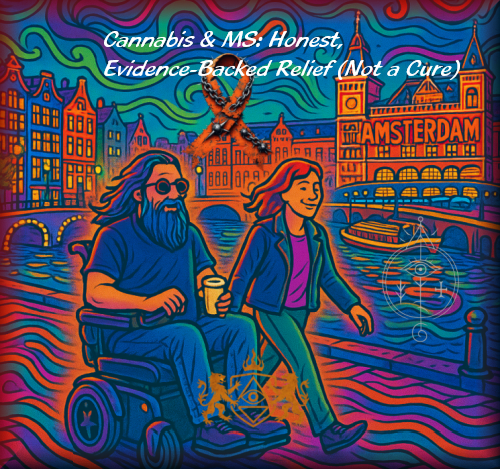
    “Cannabis isn’t a cure. But for me (and many others) it sometimes feels like lowering the waterline so I’m not constantly drowning.”

    Living with multiple sclerosis is like being handed a body that’s half-conspirator, half-prison guard. One day it lets you move, the next it locks you in with pain, spasms, and exhaustion. People who don’t live it often don’t get it. That ignorance can make conversations about treatments uncomfortable—especially when cannabis comes up.

    Cannabis still carries heavy stigma. For decades it’s been painted as the drug of lazy teenagers, a dangerous gateway, or a “last resort.” But the reality is more complicated. For many with MS, cannabis isn’t about chasing a high it’s about clawing back a bit of life. It’s not a cure, and it never will be. What it can do, in the right form, for the right person, is bring relief. Sometimes small, sometimes significant, always worth noticing.

    What the evidence actually says

    Science is messy, but let’s strip it down to what we know. Cannabis is a plant, yes, but the two compounds that matter most in MS treatment are:

    THC (tetrahydrocannabinol): The part that makes people high. Psychoactive, strong, and for some people, too much.

    CBD (cannabidiol): Doesn’t produce a high. Interacts differently in the body, often described as the calming counterpart to THC.

    Together, in carefully balanced medical products, they can target symptoms that MS brings to the table.

    Spasticity: where cannabis shines

    This is the symptom where cannabis shows the clearest benefit. Studies and lived experience show that THC+CBD sprays such as Sativex (available in the UK under specialist prescription) can reduce muscle stiffness and spasms. People report less pain, easier sleep, and more control. Clinical tools that doctors use don’t always capture the full effect, but patients’ own reports matter. Relief you can feel is relief that counts.

    Neuropathic pain: promising, but mixed

    Neuropathic pain is one of the cruellest symptoms of MS burning, stabbing, electric shocks that don’t stop. Some trials show cannabis extracts help reduce this pain, particularly when other drugs fail. Others find only modest benefits. What’s clear is that many patients experience genuine improvement, even if not every study proves it on paper.

    Sleep and quality of life: secondary gains

    When stiffness and pain ease, sleep improves. Better sleep ripples out into mood, energy, and daily functioning. These knock-on benefits often don’t make it into study data, but they matter enormously in real life.

    Why the stigma lingers

    Say “cannabis” and too many people still picture a stoner on a sofa surrounded by crisp packets. For someone with MS, that stereotype is a slap in the face. You’re not looking to escape you’re trying to ease spasticity enough to get through the night without screaming into your pillow.

    The stigma is political and cultural, not medical. Cannabis was demonised for decades, and even though attitudes are shifting, the old narratives cling on. In the UK, cannabis-based medicines are legal—but only under strict circumstances, and only through specialist doctors. Most GPs can’t or won’t prescribe. That leaves many people sourcing CBD oils or black-market products, where quality is questionable and legality is a grey cloud hanging overhead.

    Risks and realities

    Let’s not polish this into a miracle. Cannabis has risks. Honesty is what dismantles stigma, not over-promising.

    Cognitive fog: MS already messes with memory and focus. THC can worsen that for some.

    Mental health risks: High-THC strains can trigger anxiety or paranoia, especially in people already vulnerable.

    Physical side effects: Dizziness, fatigue, nausea, and changes in heart rate or blood pressure.

    Dependence: Rare with medical, controlled use, but not impossible.

    These don’t mean cannabis is “bad.” They mean it’s a tool, and tools need skill to use safely. The difference between relief and trouble often comes down to dose, formulation, and medical oversight.

    Why it matters anyway

    Here’s the thing: when you live with MS, symptom relief is gold dust.

    Even a 20% drop in pain, even one less night of spasms, even an extra hour of sleep it all adds up. That can mean the difference between being stuck in bed all day or having enough energy to make breakfast. Between drowning in pain and keeping your head above water.

    Cannabis offers that to some. Not all, not always, but enough that it deserves respect and consideration rather than judgement and whispers.

    What needs to change

    Research is still catching up. Decades of stigma slowed everything down. What we need now are:

    More trials: Larger, longer, better-designed studies.

    Clearer guidance: What dose works? Which formulation spray, oil, vapor, capsule?

    Doctor training: So patients aren’t left educating their own clinicians.

    Legal access: Safe, regulated supply that doesn’t force people into the shadows.

    Until then, people with MS continue to experiment quietly, often without the support they deserve.

    The bottom line

    Cannabis won’t cure MS. It won’t rewind the clock, repair nerves, or erase uncertainty. But it can lower the waterline. It can turn nights of relentless spasms into nights of sleep. It can dull the sharp edge of pain. It can hand back small fragments of control, and in a life where MS takes so much, those fragments matter.

    So let’s talk about cannabis without shame, without stigma, and without fantasy. Let’s call it what it is: a tool. Not a miracle, not a menace, but something that, for many, makes life with MS just a little more bearable.

    Quick facts: Cannabis & MS

    Not a cure. Cannabis doesn’t reverse MS; it’s used for symptom relief.

    Most evidence = spasticity. THC+CBD sprays (e.g., nabiximols/Sativex) show the clearest benefit for muscle stiffness and spasms.

    Pain help is promising. Many people report reduced neuropathic pain; trials are mixed but patient reports matter.

    Sleep & quality of life: Indirect benefits (better sleep, less waking from spasms) often improve day-to-day functioning.

    Risks exist: possible cognitive slowing, anxiety/paranoia with high-THC, dizziness, cardiovascular effects, and dependence risk.

    Formulation matters: spray, oil, vaping, or edibles deliver different effects — dose and ratio (THC:CBD) are key.

    Legal note (UK): Medicinal cannabis is prescribable but tightly regulated; specialist prescription is usually required.

    Practical tip: Start low, go slow. Use reliable sources and consult a clinician familiar with MS and cannabis.

    I write in ink and fury, in breath and broken bone.
    Through storm and silence, I survive. That is the crime and the miracle.

    𒀭𒊩𒆳 ᚹᚨᚱᛚᛟᚲ ᛞᚨᚱᚲ ✦ 𒀭𒊩𒆳 ᚹᚨᛏᚲᚺᛖᚱ ᚨᛗᛟᚾᚷ ᚹᚨᛏᚲᚺᛖᚱᛋ
    enter image description here

    @goblinbloggeruk - sick@mylivinghell.co.uk

  • Posted on

    ⚠️ Please read with care: This blog shares personal, sometimes painful experiences. My intention is to support and speak honestly not to harm. I’m not a professional, just someone who understands how hard it can get. If you're struggling, you're not alone please reach out for professional help.

    My brain fog is crushing. Spasms and weird electric shocks twist through me; words and sentences scramble wrong. The tinnitus that constant, maddening noise won’t quit. Some days I just want to vanish. I watch my rescue dog sleep on the webcam and envy that calm so much it hurts. Everyone offers clichés and advice they’d never follow themselves. It’s exhausting.

    I’ve asked to speak to my doctor again. I don’t know how it’ll go. If my guts blow up over the weekend I’m screwed. The dark thoughts creep in the part of me that imagines ending it and I hate that I think that. I need help. I need someone to actually see this and do something that changes it.

    Right now I’m broken, sore, and furious. I’m still here, still fighting, but not because I want to be brave because I don’t have anything left but stubbornness.

    MS isn’t cancer, but it’s its own kind of killer. It’s not Crohn’s, not ulcerative colitis I’ve had the scans, the cams, the lot. They shoved cameras where the sun don’t shine, took biopsies, waved a cheerful “nothing to worry about,” and sent me home with a sticker that says “reassured.” Fine on paper. Not fine in me.

    Let me be blunt: they sliced into the wrong place. The red patches they found were right where my MS‑riddled nerves were already a mess. They cut, they biopsied, and they left me with nerves that used to hum now screaming in high‑voltage agony. I didn’t get better. I got scorched.

    Picture me on the lavatory, clutching the edges of a stupid toilet that feels like a cliff pain so deep it isn’t even physical in the normal sense. It’s like someone rewired my insides to a broken amplifier and turned the volume to nuclear. Tears, bile, a clear spit‑drip from my mouth I can’t stop as my body fights to keep food down. I hold back vomit with every breath because the world tilts and the noise in my head goes white‑hot. I wish I were anywhere else. I wish I were normal. I wish for a million useless little things.

    The scope was a circus. First prize: the doctor’s finger, the NHS lube, and the ASMR of humiliation. “Your prostate’s fine,” he says, smiling like a man who fixed a leaking tap. That’s the comedy of it they poke, they probe, they make notes, they rule out “nasty” things, then pat you on the head and go home while your nervous system burns.

    Now the aftermath: neuropathic pain that laughs at paracetamol, spasms that feel like electric shocks through my guts and spine, brain fog that scrambles words until typing is a battle with my own brain, tinnitus that keeps me company like a sad little radio, dissociation so deep I sometimes watch someone else live my life. There are moments I cry because the pain and the not‑quite‑rightness of my head make me certain I’m splitting, losing the edges of myself. People hear me say it and step back like I’m contagious with honesty. The more truth I dump, the more people get uncomfortable and that’s lonely in its own corrosive way.

    I can’t sleep properly. I can’t plan. Every day is punctuated by the possibility that my bowels will decide to implode at the worst possible moment. I’ve learned the humiliating art of pre‑emptive management and still get blindsided. I’m on edge all the time jacked into a nervous system that lies constantly.

    And then there are the small, absurd consolations. My rescue dog Yopi decompressing on the webcam, stretching like a champion in her perfect dog‑world while I sit in mine and try not to dissolve. “Doggy wants a big poo,” the universe whispers, and I laugh like a madman because that’s the only way to keep from screaming. I even joke about the vet’s number in my phone because if my guts explode over the weekend, who do I call my vet or the NHS? It’s dark. It’s ridiculous. It’s my life.

    So yes: not cancer. Not “nasty.” Just MS doing what MS does best wrecking the wiring and turning normal procedures into torches. The biopsy didn’t fix anything. It made certain spots of nerve tissue more violent, more reactive, more relentless. That “nothing to worry about” line sits in my records like a bad joke. It doesn’t help me when the nerves scream at night and the world feels like a bad transmission.

    If you think this is melodrama, try living it. Try Googling “neuropathic bowel pain” with one hand while feeding yourself with the other when your head is full of static and your fingers don’t spell the words you mean. Try explaining to someone that the worst part isn’t dying it’s being trapped in a body that betrays you every hour while everyone treats the notes in your file as the whole story.

    I’m not looking for pity. I want acknowledgement. I want the system to stop offering livestock‑level reassurance and actually treat the neuropathic hit the biopsy dealt. I want less suffering. I want some dignity back on the lavvy. I want someone to take seriously that “not cancer” isn’t the same as “not a problem.”

    If that’s too much to ask, fine. I’ll keep shouting here where the noise won’t make anyone uncomfortable. Yopi will keep farting on camera. I’ll keep writing it down. The nerves might scream, but my voice crooked, bitter, and honest is still here.

    I write in ink and fury, in breath and broken bone.
    Through storm and silence, I survive. That is the crime and the miracle.

    𒀭𒊩𒆳 ᛞᚱᚨᚷᛟᚾ ᛏᚱᚨᚾᛋᚲᚺᚱᛁᛖᛞ ✦ ᚹᚨᛏᚲᚺᛖᚱ 𒀸𒀭 ᚢᚾᛒᛟᚢᚾᛞ
    enter image description here

  • Posted on

    ⚠️ Please read with care: This blog shares personal, sometimes painful experiences. My intention is to support and speak honestly not to harm. I’m not a professional, just someone who understands how hard it can get. If you're struggling, you're not alone please reach out for professional help.

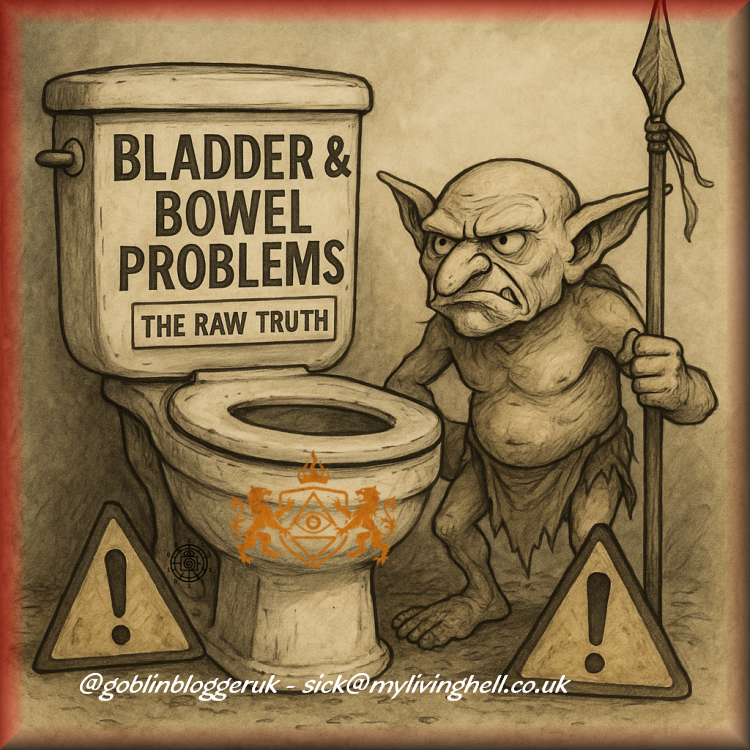
    MS doesn’t just make you trip over your own feet and forget why you went into the kitchen. It messes with the plumbing. Nerves that should quietly manage bladder and bowel signals suddenly turn into pranksters and the result is humiliation, pain, infection, and a daily game of “will I, won’t I?”

    The Bladder Circus

    What can happen:

    Urgency: You go from “fine” to “I’m going to piss myself in 10 seconds” with no warning.

    Frequency: You feel like you’ve been drinking beer all day, even if you haven’t.

    Retention: The bladder doesn’t empty properly → infection factory.

    Incontinence: The ultimate betrayal — leaks at random times.

    Why: Nerves between brain, spine, and bladder are scrambled. It’s not “just drink less tea.” It’s wiring gone wrong.

    The treatments (aka the patchwork quilt):

    Catheters: From discreet intermittent sticks to full-time plumbing. Nobody tells you it can actually be liberating (less panic, more freedom).

    Meds: Anticholinergics, beta-3 agonists — they can help, but often come with dry mouth, constipation, or zombie brain.

    Botox: Not just for faces. Injected into the bladder wall, it calms spasms. Bonus: you get to tell people your bladder is fancier than their foreheads.

    Lifestyle tweaks: Avoiding caffeine, alcohol, fizzy drinks, timed peeing. (Translation: giving up joy, but sometimes it helps.)

    The Bowel Hellscape

    What can happen:

    Constipation: Weeks of nothing, pain, bloating, then the evacuation from hell.

    Diarrhoea: The opposite. You live within sprinting distance of a toilet.

    Incontinence: Accidents. Stains. Shame. The stuff people never talk about but everyone fears.

    Why: Same reason as bladder — nerve signals scrambled. Plus fatigue means less movement, meds slow gut, diet gets wrecked.

    The treatments:

    Laxatives: Everything from gentle stool softeners to chemical warfare. Often trial and error.

    Suppositories & enemas: The glamorous life.

    Bowel training: Timed routines, diet tweaks, abdominal massage. Sometimes works, sometimes a joke.

    Pelvic floor physio: Can help with both holding in and pushing out. But access on the NHS can be patchy.

    Colostomy: The nuclear option. For some it’s actually a relief — predictable, controllable, no more humiliating accidents.

    The Real Raw Truth

    Nobody talks about it. Bladder and bowel problems are treated as shameful, so patients suffer in silence. But they’re some of the most disabling symptoms in MS.

    Doctors often gloss over it. Unless you bring it up (awkwardly), it gets ignored. Yet infections from retention can cause relapses, hospital stays, even sepsis.

    Impact is brutal. You can lose social life, intimacy, confidence, freedom. Fear of accidents dictates everything.

    Cures don’t exist. Management does. Which means a constant balancing act between side effects, dignity, and practicality.

    Humour helps. Laugh at it or drown in shame. Everyone’s got a story about public toilets, accidents, or catheters gone wrong. Talking about it takes the power back.

    Dark Sarcasm Corner

    Nurse: “Any bladder or bowel issues?” Me: “Only that they’ve staged a coup and I’m the hostage.” MS: “You wanted unpredictable symptoms? Hold my beer — oh wait, you can’t drink that anymore.”

    Conclusion

    Bladder and bowel problems with MS are not side notes — they’re daily battles. There’s no miracle cure, just messy workarounds. But if more of us talk about it openly, it kills the shame. These are not “bathroom problems.” They’re MS problems.

    You’re not weak. You’re not dirty. You’re a human with broken wiring, trying to survive with dignity intact. And if that means Botox in your bladder or a colostomy bag named Bob, so be it.

    I write in ink and fury, in breath and broken bone.
    Through storm and silence, I survive. That is the crime and the miracle.
    𐑢𐑨𐑑𐑒𐑣𐑧𐑮 𐑨𐑥𐑴𐑙 𐑢𐑨𐑑𐑒𐑣𐑧𐑮𐑕

    enter image description here

  • Posted on

    ⚠️ Please read with care: This blog shares personal, sometimes painful experiences. My intention is to support and speak honestly not to harm. I’m not a professional, just someone who understands how hard it can get. If you're struggling, you're not alone please reach out for professional help.

    Living with multiple sclerosis (MS) is a bit like being dropped into a labyrinth where the walls are invisible and the floor is made of Lego. Every day is a surprise party, but instead of cake, you get fatigue, brain fog, and a lottery of weird symptoms. Your body speaks a language all its own a sort of biological Morse code. Spoiler: it’s mostly complaints.

    1. The Body’s Whispers (AKA the Passive-Aggressive Texts from Hell)

    Your body doesn’t scream right away. Oh no. It whispers, “Maybe don’t do that,” in the kind of tone your nan uses when she means “If you do, you’ll regret it forever.” Ignore it, and you’ll get the full “MS meltdown” treatment. Learn to listen to these gentle hints before they become a four alarm disaster. Trust me, your body wants you to fail the ‘ignore me’ test.

    1. Embracing the Rollercoaster (Or, Why I’m Sometimes a Superhero and Sometimes a Sloth)

    MS is the ultimate ride. Some days you wake up and think, “Yeah, I could probably take over the world.” Other days you make sloths look like adrenaline junkies. Don’t fight it. Embrace the madness. There’s no refund for this ticket anyway. If you can laugh when your legs forget they exist, you’re already ahead.

    1. The Power of Positivity (But Not the Cheesy Kind)

    Let’s get real: “positive vibes only” is for people with motivational mugs, not MS. Real positivity is finding a smirk in the struggle. Did you get out of bed today? Bloody legend. Did you find a reason to laugh, even if it was at yourself? That’s winning. Celebrate the tiny victories because some days, they’re all you’ll get.

    1. Mindfulness: Your Secret Weapon (Or, The Only Time Silence Isn’t Suspicious)

    No, mindfulness won’t cure MS, but it might stop you from headbutting a wall. Check in with yourself. Is your body grumbling, squeaking, or plotting revenge? Maybe it’s time for a rest, a stretch, or just a massive bar of chocolate. Mindfulness: because you can’t afford to ignore the warning lights on this old banger of a body.

    1. Building Your Support Squad (Or, Assembling Your Band of Misfits)

    Find your people. The ones who get it, the ones who don’t offer herbal tea as a cure. Whether it’s other MS folk, stubborn friends, or just some poor soul who doesn’t run when you say “incontinence,” keep them close. Empathy makes the pain bearable and the jokes darker. Don’t let anyone tell you it’s weakness to ask for help—sometimes, it’s just good strategy.

    1. Finding Your Voice (Because Telepathy Still Isn’t Covered by the NHS)

    Speak up. For your needs, your rights, your weird symptoms. Don’t let the world turn you into a prop in your own life story. Your voice might tremble, but it matters. The more you say, the more others understand and maybe, just maybe, the world will get a clue.

    Bonus Track: The Legend of the Overworked Neuros

    Let’s give a round of applause (or maybe just a sarcastic slow clap) for the overworked neurologists. They’re busier than a one-legged man in an arse-kicking contest, running from clinic to clinic, dodging patients like ninjas in white coats. Actual patient appointments? That’s rich. You’re more likely to win the EuroMillions than see one before your wheelchair warranty expires.

    The NHS says “your neuro will see you now,” but what they mean is: “He’ll see you on the mural in the waiting room. Or as a hologram projected from his last known location.” Some say if you light enough scented candles and chant “re-referral” three times, a neuro will materialize… but only to tell you that your next appointment is scheduled for June 2036.

    The truth is, neuros are overworked too many people, not enough doctors, and a health system held together with sellotape and wishful thinking. But while the overworked neuro vanishes like a magician at a kids’ party, you’re left to decode your own body’s malfunctioning Morse code and hope you don’t accidentally google yourself into a full blown panic attack.

    If you do spot a neuro in the wild, be gentle. They scare easily and may bolt for the exit if approached. In the meantime, keep calm, decode your own symptoms, and remember Dr. Google and Nurse Sarcasm are open 24/7.

    Bonus Track 2: The Thankless Saints MS Nurses

    While the neurologists are off playing hide and seek, let’s talk about the true legends: MS nurses. They’re the ones on the ground, fighting fires with a teaspoon and answering emails like their keyboard’s on fire. Somehow, they manage to be calm, knowledgeable, and kind even when you’re one question away from a meltdown and have already left nine voicemails.

    MS nurses are the unsung therapists, detectives, and sometimes part-time magicians (“You’ve tried turning it off and on again? Excellent now have you tried snacks and a nap?”). They field the panicked questions neuros don’t have time for, translate medical jargon into English, and manage to keep us (and sometimes themselves) just the right side of losing it.

    Are they overworked, underpaid, and under-appreciated? Of course! Do they do it anyway, with a level of patience and gallows humour that should earn them a sainthood (or at least hazard pay)? Absolutely.

    If you’re lucky enough to have an MS nurse who answers the phone and doesn’t flinch when you ask if your “weird new symptom” means you’re dying buy them a coffee. Or a spa weekend. Or just send a thank you meme. Without them, the whole bloody NHS MS system would collapse faster than my legs after a walk to the fridge.

    So here’s to the MS nurses: holding it all together with skill, sweat, and the sort of thankless determination that deserves a medal (or at least a pint).

    Bonus Track 3: The Unsung Heroes Support Groups, Volunteers & Charities

    If you think the NHS is barely clinging on, imagine life without the MS support groups, charities, and stubborn volunteers who do it all for the love of the cause (and maybe the free biscuits at meetings).

    Support groups: These legends run by people who actually get it are the real backbone of the MS world. They’re the ones who answer your late night freak outs, decode the NHS bureaucracy, and know which GP receptionist has the good biscuits. In-person, online, or just a WhatsApp meme away, they turn “I’m losing my mind” into “You’re not alone, mate.”

    Volunteers: The ones who give their time for free, organizing meet-ups, fundraising, sending out info packs, and listening to rants from people like us without ever losing their patience. Half the time, they’re managing their own MS or supporting someone who is but you’d never know, because they’re too busy holding everyone else up.

    Charities: Whether it’s the MS Society, MS Trust, Shift.ms, Overcoming MS, MS-UK, or any of the local grassroots warriors, they’re out there lobbying, funding research, and somehow keeping hope alive in a world that sometimes feels like it’s sponsored by despair. Without them, you’d still be Googling “what the hell is MS” while the NHS phone queue loops you back to start.

    Are they underfunded, overstretched, and powered mostly by stubbornness and biscuits? You’d better believe it. Do they keep the whole community from falling through the cracks? Absolutely.

    So here’s a genuine, sarcastic-but-serious thank you to every support group, volunteer, and charity keeping the MS circus running. If you ever wondered who the real unsung heroes are it’s the lot turning lived chaos into lifelines.

    Raise a mug (or a wheelchair, or just an eyebrow) for them they’ve earned it.

    Conclusion: Embrace the Weird, Survive the Storm

    Living with MS means forever learning a new dialect of pain, fatigue, and absurdity. The “invisible code” is always changing, but your ability to listen and laugh might just be the best tool you have. Don’t sugar-coat it. Don’t let anyone else either.

    So here’s to listening to your body, celebrating every little win, and flipping MS the metaphorical V-sign as often as possible. You’re not alone. And you’re not invisible.

    Now, go on decode the next bloody signal. And if you’re looking for rainbow platitudes, you’re in the wrong blog.

    I write in ink and fury, in breath and broken bone.
    Through storm and silence, I survive. That is the crime and the miracle.

    enter image description here