
Multiple sclerosis is My Living Hell

MS symptoms

All posts tagged MS symptoms by Multiple sclerosis is My Living Hell
  • Posted on

    ⚠️ Please read with care: This blog shares personal, sometimes painful experiences. My intention is to support and speak honestly not to harm. I’m not a professional, just someone who understands how hard it can get. If you're struggling, you're not alone please reach out for professional help.

    Living with multiple sclerosis (MS) is a bit like being dropped into a labyrinth where the walls are invisible and the floor is made of Lego. Every day is a surprise party, but instead of cake, you get fatigue, brain fog, and a lottery of weird symptoms. Your body speaks a language all its own a sort of biological Morse code. Spoiler: it’s mostly complaints.

    1. The Body’s Whispers (AKA the Passive-Aggressive Texts from Hell)

    Your body doesn’t scream right away. Oh no. It whispers, “Maybe don’t do that,” in the kind of tone your nan uses when she means “If you do, you’ll regret it forever.” Ignore it, and you’ll get the full “MS meltdown” treatment. Learn to listen to these gentle hints before they become a four alarm disaster. Trust me, your body wants you to fail the ‘ignore me’ test.

    1. Embracing the Rollercoaster (Or, Why I’m Sometimes a Superhero and Sometimes a Sloth)

    MS is the ultimate ride. Some days you wake up and think, “Yeah, I could probably take over the world.” Other days you make sloths look like adrenaline junkies. Don’t fight it. Embrace the madness. There’s no refund for this ticket anyway. If you can laugh when your legs forget they exist, you’re already ahead.

    1. The Power of Positivity (But Not the Cheesy Kind)

    Let’s get real: “positive vibes only” is for people with motivational mugs, not MS. Real positivity is finding a smirk in the struggle. Did you get out of bed today? Bloody legend. Did you find a reason to laugh, even if it was at yourself? That’s winning. Celebrate the tiny victories because some days, they’re all you’ll get.

    1. Mindfulness: Your Secret Weapon (Or, The Only Time Silence Isn’t Suspicious)

    No, mindfulness won’t cure MS, but it might stop you from headbutting a wall. Check in with yourself. Is your body grumbling, squeaking, or plotting revenge? Maybe it’s time for a rest, a stretch, or just a massive bar of chocolate. Mindfulness: because you can’t afford to ignore the warning lights on this old banger of a body.

    1. Building Your Support Squad (Or, Assembling Your Band of Misfits)

    Find your people. The ones who get it, the ones who don’t offer herbal tea as a cure. Whether it’s other MS folk, stubborn friends, or just some poor soul who doesn’t run when you say “incontinence,” keep them close. Empathy makes the pain bearable and the jokes darker. Don’t let anyone tell you it’s weakness to ask for help—sometimes, it’s just good strategy.

    1. Finding Your Voice (Because Telepathy Still Isn’t Covered by the NHS)

    Speak up. For your needs, your rights, your weird symptoms. Don’t let the world turn you into a prop in your own life story. Your voice might tremble, but it matters. The more you say, the more others understand and maybe, just maybe, the world will get a clue.

    Bonus Track: The Legend of the Overworked Neuros

    Let’s give a round of applause (or maybe just a sarcastic slow clap) for the overworked neurologists. They’re busier than a one-legged man in an arse-kicking contest, running from clinic to clinic, dodging patients like ninjas in white coats. Actual patient appointments? That’s rich. You’re more likely to win the EuroMillions than see one before your wheelchair warranty expires.

    The NHS says “your neuro will see you now,” but what they mean is: “He’ll see you on the mural in the waiting room. Or as a hologram projected from his last known location.” Some say if you light enough scented candles and chant “re-referral” three times, a neuro will materialize… but only to tell you that your next appointment is scheduled for June 2036.

    The truth is, neuros are overworked too many people, not enough doctors, and a health system held together with sellotape and wishful thinking. But while the overworked neuro vanishes like a magician at a kids’ party, you’re left to decode your own body’s malfunctioning Morse code and hope you don’t accidentally google yourself into a full blown panic attack.

    If you do spot a neuro in the wild, be gentle. They scare easily and may bolt for the exit if approached. In the meantime, keep calm, decode your own symptoms, and remember Dr. Google and Nurse Sarcasm are open 24/7.

    Bonus Track 2: The Thankless Saints MS Nurses

    While the neurologists are off playing hide and seek, let’s talk about the true legends: MS nurses. They’re the ones on the ground, fighting fires with a teaspoon and answering emails like their keyboard’s on fire. Somehow, they manage to be calm, knowledgeable, and kind even when you’re one question away from a meltdown and have already left nine voicemails.

    MS nurses are the unsung therapists, detectives, and sometimes part-time magicians (“You’ve tried turning it off and on again? Excellent now have you tried snacks and a nap?”). They field the panicked questions neuros don’t have time for, translate medical jargon into English, and manage to keep us (and sometimes themselves) just the right side of losing it.

    Are they overworked, underpaid, and under-appreciated? Of course! Do they do it anyway, with a level of patience and gallows humour that should earn them a sainthood (or at least hazard pay)? Absolutely.

    If you’re lucky enough to have an MS nurse who answers the phone and doesn’t flinch when you ask if your “weird new symptom” means you’re dying buy them a coffee. Or a spa weekend. Or just send a thank you meme. Without them, the whole bloody NHS MS system would collapse faster than my legs after a walk to the fridge.

    So here’s to the MS nurses: holding it all together with skill, sweat, and the sort of thankless determination that deserves a medal (or at least a pint).

    Bonus Track 3: The Unsung Heroes Support Groups, Volunteers & Charities

    If you think the NHS is barely clinging on, imagine life without the MS support groups, charities, and stubborn volunteers who do it all for the love of the cause (and maybe the free biscuits at meetings).

    Support groups: These legends run by people who actually get it are the real backbone of the MS world. They’re the ones who answer your late night freak outs, decode the NHS bureaucracy, and know which GP receptionist has the good biscuits. In-person, online, or just a WhatsApp meme away, they turn “I’m losing my mind” into “You’re not alone, mate.”

    Volunteers: The ones who give their time for free, organizing meet-ups, fundraising, sending out info packs, and listening to rants from people like us without ever losing their patience. Half the time, they’re managing their own MS or supporting someone who is but you’d never know, because they’re too busy holding everyone else up.

    Charities: Whether it’s the MS Society, MS Trust, Shift.ms, Overcoming MS, MS-UK, or any of the local grassroots warriors, they’re out there lobbying, funding research, and somehow keeping hope alive in a world that sometimes feels like it’s sponsored by despair. Without them, you’d still be Googling “what the hell is MS” while the NHS phone queue loops you back to start.

    Are they underfunded, overstretched, and powered mostly by stubbornness and biscuits? You’d better believe it. Do they keep the whole community from falling through the cracks? Absolutely.

    So here’s a genuine, sarcastic-but-serious thank you to every support group, volunteer, and charity keeping the MS circus running. If you ever wondered who the real unsung heroes are it’s the lot turning lived chaos into lifelines.

    Raise a mug (or a wheelchair, or just an eyebrow) for them they’ve earned it.

    Conclusion: Embrace the Weird, Survive the Storm

    Living with MS means forever learning a new dialect of pain, fatigue, and absurdity. The “invisible code” is always changing, but your ability to listen and laugh might just be the best tool you have. Don’t sugar-coat it. Don’t let anyone else either.

    So here’s to listening to your body, celebrating every little win, and flipping MS the metaphorical V-sign as often as possible. You’re not alone. And you’re not invisible.

    Now, go on decode the next bloody signal. And if you’re looking for rainbow platitudes, you’re in the wrong blog.

    I write in ink and fury, in breath and broken bone.
    Through storm and silence, I survive. That is the crime and the miracle.
    enter image description here

  • Posted on

    ⚠️ Please read with care: This blog shares personal, sometimes painful experiences. My intention is to support and speak honestly not to harm. I’m not a professional, just someone who understands how hard it can get. If you're struggling, you're not alone please reach out for professional help.

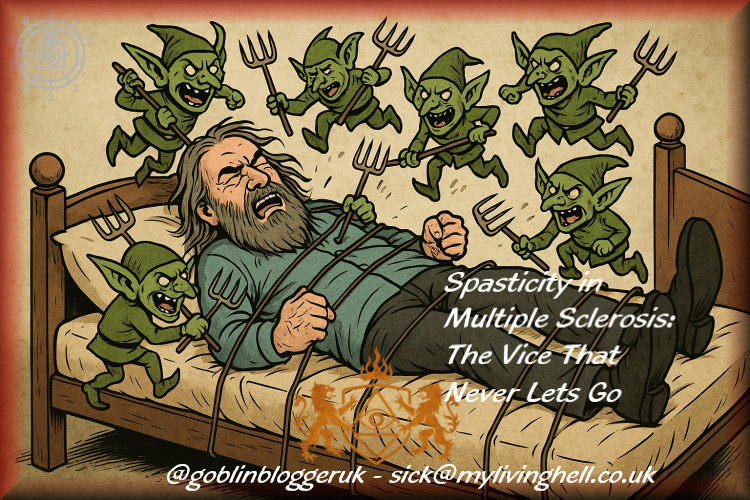
    Three a.m. and my legs are iron bars. I’m awake not because of a dream, but because my own body has turned into a torture rack. Spasticity they call it. Clinical word, clean and tidy. In reality it’s a bloody vice clamped round your muscles until you want to scream.

    What it actually is: spasticity means the muscle tone is cranked up to the point where any movement meets resistance . It isn’t “just stiff legs” or “tense muscles” it’s misfiring wiring. MS strips the insulation (myelin) off nerves, so the “relax” signal never makes it down the line. Muscles seize, jerk, lock, and sometimes kick out without warning.

    Lived reality:

    Waking with calves twisted like a corkscrew.

    Trying to stand and finding your knees welded shut.

    A jolt through your thigh like your body just sucker-punched you.

    Nights lost to a body that refuses to sleep.

    The so-called toolbox:

    First line: baclofen, tizanidine, diazepam, dantrolene—sedating, imperfect, but sometimes the only rope you’ve got .

    If those fail, the UK’s NICE guidelines say offer a 4-week trial of THC:CBD spray (Sativex) for moderate to severe spasticity . That’s the first cannabis-based medicine ever licensed here.

    When it’s brutal, intrathecal baclofen pumps drip the drug straight into your spinal fluid. It works. It’s invasive. It’s not offered nearly enough .

    Exercise and movement help stop muscles chaining up , but let’s be clear: stretching alone won’t magically fix spasticity .

    Triggers that fan the flames: infections, fever, overheating, tight clothes, constipation, pain, stress, fatigue, even a full bladder . Everyday stuff that flips a switch and makes your body lock.

    Why it matters: spasticity doesn’t just steal mobility—it steals sleep, dignity, spontaneity. It turns daily life into a constant negotiation with your own muscles. That’s not “just another symptom.” That’s a thief.

    References (for readers who want the receipts)

    NICE NG144 (2019): Cannabis-based medicines in MS

    Cochrane review (2024): Cannabinoids and spasticity

    AAN guideline: Oral anti-spasticity meds

    UK MS Society: Exercise reduces spasticity

    New evidence: stretching not a cure-all

    Intrathecal baclofen: long-term safe and effective

    I write in ink and fury, in breath and broken bone.
    Through storm and silence, I survive. That is the crime and the miracle.
    enter image description here

  • Posted on

    ⚠️ Please read with care: This blog shares personal, sometimes painful experiences. My intention is to support and speak honestly not to harm. I’m not a professional, just someone who understands how hard it can get. If you're struggling, you're not alone please reach out for professional help.

    Ah, brain fog. That delightful little feature where your mind suddenly feels like it’s been filled with cold treacle and you can’t remember the name of the person you’ve been married to for 20 years. Or whether you actually had lunch… or just thought about it really hard.

    What It Is In scientific terms, cognitive dysfunction means your brain’s processing power has taken a long weekend without permission. It can affect memory, focus, problem-solving, and that delicate social skill of not blurting out something wildly inappropriate.

    In lived experience terms, it’s that moment you stare at your kettle wondering why the hell your phone charger won’t fit into it.

    Causes Chronic Illness – MS, ME/CFS, fibromyalgia, autoimmune fun, and anything else ending in “-itis” can bring brain fog as a bonus prize.

    Fatigue – Mental or physical exhaustion turns your brain into that Windows 95 PC your uncle swore “was fine until last week.”

    Medication Side-Effects – Because why just fix one thing when you can break another?

    Stress & Anxiety – Fight-or-flight mode is great for escaping lions, less useful for remembering your online banking password.

    Hormonal Swings – Menopause, thyroid issues, or just the monthly “I hate everything” cycle.

    Symptoms Words that escape mid-sentence like startled pigeons.

    Reading the same sentence five times and still having no clue what it says.

    Forgetting why you walked into a room (it’s never for anything good).

    Thinking slower than dial-up internet.

    Why It’s Not ‘Just Being Tired’ People without brain fog love to tell you “Oh, I forget things too!” Yes, Sharon, but you don’t lose the ability to spell your own surname halfway through writing it.

    Brain fog isn’t about being a bit sleepy. It’s about your entire mental operating system running on one bar of battery and 57 background processes you never asked for.

    Coping Strategies (Sort Of) Lists – Post-its, phone reminders, writing on your hand… whatever keeps the chaos contained.

    Pacing Yourself – Which really means doing one thing, then lying down in a dark room regretting it.

    Accepting Help – Even if it’s from people who think you’re “just being lazy.”

    Humour – Laughing about it doesn’t fix anything, but it makes the slow mental collapse less depressing.

    I write in ink and fury, in breath and broken bone.
    Through storm and silence, I survive. That is the crime and the miracle.
    enter image description here

  • Posted on

    ⚠️ Please read with care: This blog shares personal, sometimes painful experiences. My intention is to support and speak honestly—not to harm. I’m not a professional, just someone who understands how hard it can get. If you're struggling, you're not alone—please reach out for help.

    🏡 Chapter 1: What in the name of Whizzer IS Multiple Sclerosis?! Picture it: The Bumpkin Billionaires inherit a CT scanner and decide to diagnose me.

    “Reckon yer brain’s leakin’ somethin’, boy!” says Pa Bumpkin, sticking the plug into a turnip.

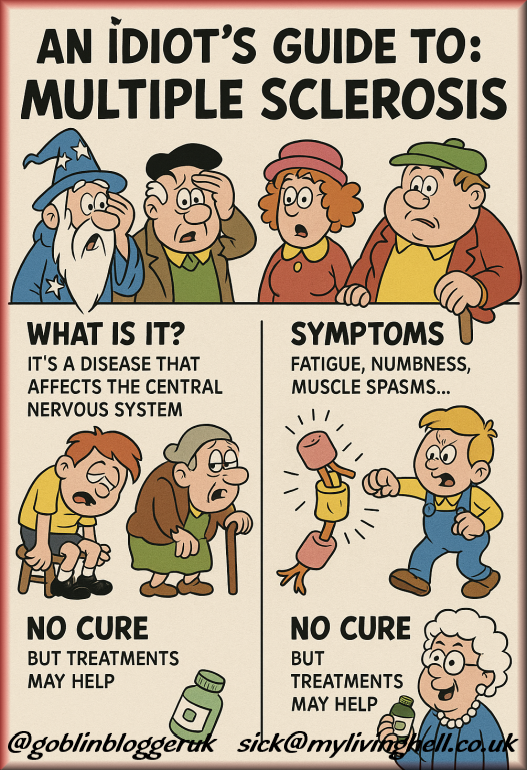
    🧠 Real Talk: MS is a condition where your immune system has a hissy fit and starts attacking the protective sheath (myelin) around your nerves. It’s like wrapping your wires in wet loo roll and expecting your kettle to work.

    🐍 Chapter 2: Symptoms, or “Why is my leg doing the Macarena?” Sid’s Snake is wriggling around my spinal cord: “Ere Sid, why’s ‘is leg twitchin’? You got batteries in yer bum again?”

    🔁 Common MS Symptoms:

    Numbness

    Brain fog (or as Sid calls it, “Soggy noggin”)

    Spasticity (tight muscles, not what they used to call you at school)

    Fatigue that hits like a cricket bat to the soul

    Vision like someone smeared jam on your eyeballs

    💸 Chapter 3: Diagnosis – Not a Game of ‘Guess Who?’ Odd-Ball tries to diagnose you by morphing into a GP, a neurologist, and a confused chicken.

    🎲 Real Talk: Getting diagnosed with MS involves MRIs, lumbar punctures, blood tests, and usually a couple of years of gaslighting.

    “You’re just stressed, love.” “You just need more exercise.” “You’ve got a trapped nerve.”

    Or as Odd-Ball puts it: “Have you tried turning your spinal cord off and on again?”

    🍰 Chapter 4: Living With MS – Like Baking a Cake With No Recipe and a Flamethrower Ma Bumpkin tries to make me a wellness cake: “Put in some turmeric, a crystal, and chant at it, that’ll fix yer myelin!”

    💀 Truth Bomb: Living with MS means daily unpredictability, social misunderstanding, and trying not to murder people who say “But you don’t look ill.”

    🛏️ Chapter 5: Fatigue – Not Just Tired, Knackered Beyond the Grave Shiner from Chips tries to outrun me in a wheelchair race. Shiner wins. I am still in bed.

    🧠 “Fatigue in MS isn’t just ‘sleepy’. It’s a lead weight in your bones, a fog in your brain, and a punch to your will to live.”

    🧙‍♂️ Chapter 6: MS Treatments – Magic Potions and Bloody Side Effects Professor Nutty from Whizzer and Chips tries to cure me with an exploding cauldron and a DIY infusion.

    💊 In Real Life:

    DMTs (disease-modifying therapies) might slow the MS progression

    Steroids for relapses

    Gabapentin, Baclofen, and “every pill under the sun” for the other crap

    Side effects? Oh yes. All of them.

    🧼 Chapter 7: Coping Mechanisms – Or ‘How I Learned to Stop Crying and Love the Chaos’ The Bumpkin Billionaires start an MS yoga retreat with goats, mud, and sausages. It fails catastrophically.

    🛠️ Real tips:

    Keep a sarcastic blog (tick)

    Own your story

    Take breaks before your body breaks you

    Ask for help (but don’t expect people to understand)

    Cultivate dark humour like a fine mouldy cheese

    👹 Final Word from me This isn’t your mum’s guide to MS. This is a piss-stained, tea-spilled, rage-and-laughter-soaked survival manual for living with something that tries to break you every bloody day. And like Sid’s Snake, I twist, I turn, but I’m still slithering on.

    I write in ink and fury, in breath and broken bone.
    Through storm and silence, I survive. That is the crime and the miracle.
    enter image description here

  • Posted on

    Some days your brain is soup. Some days it’s concrete. Today mine is both—a sticky tumble of wet cement and electrostatic jelly swirling around like a demonic blancmange on spin cycle.

    And let’s not forget the tinnitus. That oh-so-charming eeeeeeeeeeeeeeeee that makes me feel like I’m forever tuned to a pirate radio station broadcasting from Satan’s sock drawer.

    Is it a message from the divine? A transmission from the veil? Perhaps. But I forgot to pay for the decoder, so it’s just bloody static in my skull.

    My eyes? Seeing things. Unexplainable things. Optician said I was "fine". Yeah—fine. As in "fine for someone actively phasing in and out of reality like a dodgy antenna from a 1970s TV shop in Slough."

    The mists roll in. Not poetic mists—these bastards come like memory locusts, stripping every useful thought from my mind and leaving behind a soggy field of what-the-fuck.

    The Itch. Oh yes, that itch. Not pain. Not even discomfort. A curse. A divine punishment. Same place. Every bloody time. Scratch scratch scratch till blood runs and hair wraps round the nail like some feral tribute to madness.

    You don’t feel it immediately. No, that would be merciful. It waits. It watches. And then it writhes beneath your skin like it’s got a schedule to keep.

    I’m dizzy. Sick. Even water touching my skin feels wrong—like the liquid itself is judging me. I scream into pillows now. It's my new therapy. Pillows don’t judge. Pillows just muffle.

    Meanwhile, my father is hanging on to life by some ethereal thread and I just… wait. Wait for a message. Wait for a call. Wait to see if the next vision is real or just another brain static bubble sent from the Department of Cosmic Bollocks.

    I am tired. I am haunted. I am heavy.

    And I am still here.

                                !!DISCLAIMER !!
    

    This blog shares raw and personal experiences with mental and physical health. Some posts may be triggering. I'm not a professional - just writing my truth. Please don't take this as medical advice.

            “The views in this post are based on my personal      
              experience. I do not intend harm, only honesty.”   
    
                “By ink and breath and sacred rage, I write.
                        By storm and silence, I survive.”
    

    enter image description here

          @goblinbloggeruk  - sick@mylivinghell.co.uk