- Posted on
⚠️ This blog shares my personal, sometimes painful experiences with MS and mental health. My intention is to speak honestly and offer solidarity—not to harm or replace professional advice. I’m not a doctor or therapist, just someone who gets how hard it can get. If you’re struggling, you’re not alone. Please reach out to a trusted friend, support group, or professional. You deserve help and hope.⚠️
please remember I suffer with severe cognitive dysfunction this may be a confusing read. AI help with content
A very good afternoon ,evening, or morning,to all who read this blog, I know its Thursday..my spellings getting insane so need more help..my eye sights getting worse.. oh joy this day brings lol...
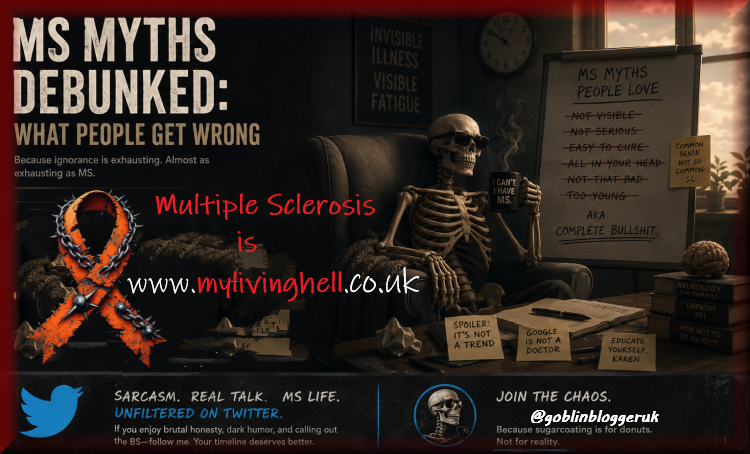
MS Myths Debunked What People Get Wrong (And Why Google Isn't a Neurologist)
Let's play a game.
Take a shot every time someone says one of these classics:
"But you don't look sick."
"My cousin's neighbour's dog walker cured it with bonzo dog food."
"At least it's not cancer."
Actually... don't. Alcohol and MS fatigue are already in enough of a toxic relationship.
If you live with Multiple Sclerosis, you've probably heard enough unsolicited medical opinions to qualify for an honorary degree in Other People's Bollocks.
It's fascinating, really.
You spend years dealing with neurologists, MRIs, blood tests, medications and symptoms that make absolutely no sense...
...then some anonymous person from social media confidently informs you that all you really need is turmeric.
Remarkable.
Myth #1: "You Don't Look Sick."
Brilliant observation.
You also don't look like you have Wi-Fi, anxiety or a mortgage, yet somehow all three exist.
MS is often called an invisible illness because many symptoms can't be seen.
Fatigue. Pain. Brain fog. Balance problems. Numbness. Vision issues.
They're all real whether they come with flashing neon signs or not.
Just because someone smiled today doesn't mean they aren't paying for it tomorrow.
Human beings aren't mood rings.
Myth #2: "You're Too Young To Have MS."
MS doesn't politely wait until retirement.
Many people are diagnosed between the ages of 20 and 40.
Apparently autoimmune diseases never received the memo about age restrictions.
If they had, neurologists would have considerably less paperwork.
Myth #3: "Have You Tried..."
Yes.
I've tried medication.
Physiotherapy.
Exercise.
Rest.
Diet changes.
Supplements.
Yoga.
Stretching.
Hope.
Denial.
Swearing creatively.
I've even tried pretending everything's fine.
Spoiler:
That one lasted until Tuesday.
The internet has convinced an alarming number of people that watching three YouTube videos somehow outranks years of neurological research.
Congratulations.
You've mistaken confidence for competence.
Myth #4: "It's All In Your Head."
Technically...
Yes.
That's literally where the lesions are.
Congratulations on accidentally stumbling into medical accuracy.
Unfortunately, that's where your expertise ends.
MS is a disease where the immune system attacks the protective covering around nerves, disrupting communication between the brain and the rest of the body.
It's neurological.
Not imaginary.
There's a rather significant difference.
Myth #5: "My Friend Has MS And They're Fine."
Excellent.
My mate owns a Labrador.
That doesn't mean every dog behaves the same.
MS is famously unpredictable.
No two people experience it the same way.
Some have relapsing symptoms.
Others experience gradual progression.
Some use mobility aids.
Some don't.
Some work full-time.
Some can't.
Comparing one person with MS to another is about as scientific as comparing apples to traffic cones.
Myth #6: "You're Just Tired."
No.
You're tired.
I'm experiencing fatigue.
There's a difference.
Being tired is needing another coffee.
MS fatigue is feeling like someone unplugged your batteries, replaced your bones with wet cement and then expected you to function like nothing happened.
It's not laziness.
It's not lack of motivation.
It's one of the most disabling symptoms many people with MS experience.
Myth #7: "There's Probably A Cure They're Hiding."
Ah yes.
The secret underground vault where scientists keep cures next to Bigfoot, Atlantis and common sense on social media.
Medical research is improving all the time.
Treatments have advanced enormously.
Many people now live fuller, longer lives because of disease-modifying therapies.
But there isn't a miracle cure hidden behind a curtain while neurologists twirl moustaches and laugh maniacally.
Real science isn't a Netflix conspiracy documentary.
It's slower.
Messier.
And considerably less exciting.
The Real Problem
The biggest disability many people with MS face isn't always the disease.
Sometimes it's ignorance dressed up as kindness.
People mean well.
Mostly.
But good intentions don't magically become useful information.
Sometimes the most helpful thing you can say is astonishingly simple.
"I'm sorry you're dealing with that."
"How are you today?"
"Can I help?"
No miracle diets.
No Facebook research.
No comparing them to your aunt's hairdresser.
Just empathy.
It's free.
Unlike most prescriptions.
Final Thought
Living with MS already means adapting to uncertainty.
Nobody needs the added bonus of becoming an unpaid myth-buster every time they leave the house.
So before offering advice nobody requested...
Before assuming someone is "fine" because they're smiling...
Before announcing you've discovered the cure via an influencer selling herbal powder...
Pause.
Remember that the person living with MS probably knows more about it than the bloke commenting underneath a cat video.
Empathy will always age better than ignorance.
And unlike internet experts...
It doesn't require Wi-Fi.
wishing all the readers of my blog peace healing love and light no matter who you are ....
Warlock Dark Chronic illness survivor, truth-teller, occasional bastard. From My Living Hell (For those who came here by accident: yes, my living hell is real. And yes, we still fight. Every shitty day. With defiance.)