Multiple sclerosis is My Living Hell

natural medicine

All posts tagged natural medicine by Multiple sclerosis is My Living Hell
  • Posted on

    ⚠️ Please read with care: This blog shares personal, sometimes painful experiences. My intention is to support and speak honestly not to harm. I’m not a professional, just someone who understands how hard it can get. If you're struggling, you're not alone please reach out for professional help.

    By Warlock Dark — The Kittens-of-Doom-Tolerated Version

    Let me tell you something most doctors won’t say out loud because it ruins the tidy little world they live in: there is no such thing as “multiple sclerosis”. Not as one thing. Not as one condition. Not as one neat textbook chapter.

    What exists out here, in the trenches where the real people live, is millions of different versions of MS one for every poor sod whose nervous system it chose to torment.

    My MS isn’t your friend’s MS. Your friend’s MS isn’t your neighbour’s MS. And your neighbour’s MS isn’t the version your doctor read about at medical school 30 years ago before caffeine, stress and pharmaceuticals turned their brain into soup.

    That’s the real problem. And that’s what nobody talks about.

    So today I’m talking about it.

    Because this isn’t theory this is my lived experience, and the lived experience of every chronic illness warrior out there who’s been patronised, misdiagnosed, over-prescribed, under-listened to and told to “trust the science” while their body is doing a completely different opera in a completely different key.

    Your MS Is Not My MS And That’s the Heart of the Issue

    I’ve been dealing with this beast for years. And it didn’t take long to realise the obvious truth: MS behaves differently in every single person.

    Not a little bit differently but massively, dramatically differently. To the point where two MS patients in the same postcode can look like they’ve got completely unrelated illnesses.

    One gets fatigue. One gets spasms. One gets cognitive collapse. One gets mood surges. One gets vision problems. One gets pain. One gets none of the above. One gets all the above. One wakes up feeling normal and collapses by afternoon. One collapses in the morning and rallies at night like a nocturnal raccoon.

    And somehow… the medical system insists it’s all the same condition.

    It’s not.

    It never has been.

    It never will be.

    MS is not a single disease it is a collection of personalised neurological catastrophes wearing the same name tag.

    Every nervous system reacts differently. Every immune profile is different. Every flare is different. Every trauma history matters. Every hormonal cycle matters. Every bit of diet tolerance matters. Every gut problem matters. Every tiny bit of stress matters. MS is a fingerprint, not a formula.

    This is why the “one size fits all” approach to treatment falls apart before it even starts.

    Doctors Don’t Live in Our Bodies That’s the Core Failure

    Let’s be blunt. Doctors don’t have MS. They don’t wake up with burning nerves, spasming muscles, brain fog thick enough to butter bread with, or the charming experience of waking up in a body that refuses to obey basic commands.

    They don’t know the sudden dread of a flare. They don’t know the nights where the pain turns you into a sleepless, twitching banshee. They don’t know the fear that comes from a throat that stops working, or a leg that decides it’s clocking off for the day.

    And because they don’t live it, they can only treat it academically. Which works about as well as giving someone directions to a town you’ve never visited.

    Medicine needs to stop pretending everything is predictable. It’s not. The only predictable thing about MS is its unpredictability.

    Why Natural Medicine Often Works Better Than Pharma The Truth Nobody Likes to Hear

    Let me be clear: this isn’t anti-science. This is anti-stupidity. There’s a difference.

    I’ve done the pharma route. I’ve swallowed the pills. I’ve taken the injections. I’ve sat in the chair for the infusions. And I’ve been in the hell where you take one drug, and then three more drugs to counteract the first drug, and then another drug to deal with the side effects of the side effects.

    It’s not a treatment plan. It’s a chemical hostage situation.

    Polypharmacy wrecks people. Not sometimes often.

    It makes fatigue worse. It makes cognition worse. It messes with the gut. It interacts with itself. And before you know it, you’re a walking medicine cabinet with a pulse.

    Natural medicine? It does something the pharmaceutical world still struggles with:

    It treats the person, not the “average patient”.

    That’s why medical cannabis changed my life. THC has been more stabilising for me than a decade of prescription chaos.

    Lion’s Mane helped my cognition when nothing else did. Vitamin D and magnesium did more for my mood and nerves than SSRIs ever could. Some things worked. Some things didn’t. But the point is: they worked according to my biology, not a clinical trial with 500 strangers.

    That’s the golden rule chronic illness patients learn the hard way:

    There is no universal cure because there is no universal body.

    Everyone’s Illness Is a Different Monster — Even with the Same Name

    Here’s the part doctors don’t like:

    Two people can have “the same illness” and need completely different treatments, foods, drugs, supplements, or habits.

    Your body might be able to tolerate one thing that destroys someone else’s stomach. Your nervous system might benefit from THC while someone else gets overwhelmed by it. You might thrive on Lion’s Mane while someone else feels nothing.

    That’s not placebo. That’s biology. Neurology is personal. Immunity is personal. Trauma is personal. Symptoms are personal. So treatment has to be personal too.

    No neurologist’s office in the world is set up for this kind of nuance. But it’s the only approach that works.

    What the System Doesn’t Understand But Patients Do

    The real experts are the ones living with the condition.

    Not the clinicians. Not the researchers. Not the textbooks.

    The people who wake up inside these bodies every day.

    We understand patterns doctors miss. We recognise triggers before blood tests do. We notice neurological shifts before MRI scans catch up.

    We know when food wrecks us. We know when weather hits us. We know when stress snaps something inside us. We know when the meds help — and when they poison.

    And the reason we know is simple:

    We don’t have the luxury of being wrong.

    Doctors can be wrong and move on. Patients pay the price.

    Your MS, My MS, and the Future of Chronic Illness

    Here’s the truth I wish the world would catch up to:

    MS should be treated as dozens of sub-types, not one umbrella diagnosis.

    If medicine ever wants to improve MS outcomes, it needs to:

    personalise treatment

    map symptom patterns

    respect lived experience

    stop treating outliers as “exceptions”

    integrate natural therapies

    merge medical science with actual patient data

    stop pretending everyone’s body reacts the same

    People aren’t machines. Bodies aren’t standardised. And chronic illness doesn’t follow rules.

    You want real progress? Start listening to the people living the reality — not just the ones writing the guidelines.

    My Conclusion? Simple. Brutal. True.

    Your MS is yours. Mine is mine. Nobody experiences the same version, and nobody should be treated like they do. Doctors need to understand this. Medicine needs to evolve. And patients deserve to be treated as individuals, not numbers on a chart. Until the system catches up, we keep learning our bodies the hard way — one flare, one insight, one victory at a time. And honestly? Lived experience isn’t just “valuable”. It’s the only thing that actually saves lives. Warlock Dark Chronic illness survivor, truth-teller, occasional bastard. From My Living Hell (For those who came here by accident: yes, my living hell is real. And yes, we still fight. Every shitty day. With defiance.)

    @goblinbloggeruk - sick@mylivinghell.co.uk
    𒀭𒊩𒆳 ᛞᚱᚨᚷᛟᚾ ᛏᚱᚨᚾᛋᚲᚺᚱᛁᛖᛞ ✦ ᚹᚨᛏᚲᚺᛖᚱ 𒀸𒀭 ᚢᚾᛒᛟᚢᚾᛞ
    enter image description here

  • Posted on

    ⚠️ Please read with care: This blog shares personal, sometimes painful experiences. My intention is to support and speak honestly not to harm. I’m not a professional, just someone who understands how hard it can get. If you're struggling, you're not alone please reach out for professional help.

    Mushrooms are not plants. They’re not animals. They’re the great in-betweeners, nature’s underground internet, recycling death into nutrients and occasionally blowing your head off with psilocybin visions. They’re also medicine, food, and for some of us, desperate hope in capsule form.

    I’ve been taking Lion’s Mane mushrooms every day for about a year. Two capsules, 500 mg each. Do I feel like Einstein yet? Not really. Placebo? Possibly. Brain-food insurance policy? Definitely. Let’s look at the evidence, the folklore, and the sheer weirdness.

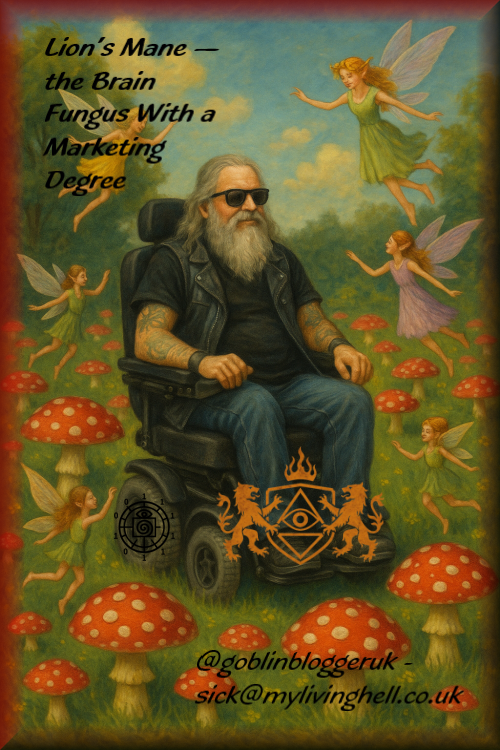
    Lion’s Mane the Brain Fungus With a Marketing Degree

    Lion’s Mane (Hericium erinaceus) looks like a frozen white waterfall or a wig for ghosts. It’s been used in traditional Chinese medicine for centuries. In the West, supplement sellers market it as “neuroprotective” and “cognitive boosting.”

    What Science Says (so far):

    Contains compounds called hericenones and erinacines, which in lab studies stimulate nerve growth factor (NGF) — the stuff that encourages neurons to survive and grow. (nih.gov )

    Animal studies suggest Lion’s Mane can promote remyelination (repair of the nerve sheath) the dream ticket for people with MS. Early evidence, but promising.

    Small human studies show modest improvements in cognitive function in older adults with mild cognitive impairment. Nothing blockbuster yet, but encouraging.

    Anti-inflammatory and antioxidant properties the general “helps the body deal with stress” box ticked.

    The Limits:

    Clinical trials in humans with MS, Parkinson’s, or other neurodegenerative conditions? Very few, very small.

    Supplements are unregulated. What’s in your capsule depends on the brand. Could be pure, could be sawdust.

    Effects are subtle. Don’t expect to grow new neurons overnight. If you notice anything, it’s likely over months and alongside other lifestyle factors.

    Mushrooms in General — The Fungal Pharmacy

    It’s not just Lion’s Mane. Mushrooms are chemical factories with real power:

    Reishi (Ganoderma lucidum): “The mushroom of immortality.” Immunomodulating, calming, possibly anti-cancer effects.

    Cordyceps: Energy booster, oxygen uptake improver, libido aid. Essentially the creepy parasite of caterpillars turned into performance enhancer.

    Chaga: Antioxidant powerhouse, skin and gut friendly. Looks like burnt charcoal but packs a punch.

    Psilocybin (magic mushrooms): Illegal in most places, but clinical trials show strong effects on depression, PTSD, end-of-life anxiety. Sometimes one dose = months of relief.

    Plain edible mushrooms (button, shiitake, oyster): Not flashy, but full of fibre, B vitamins, selenium, and beta-glucans that quietly help immunity tick along.

    Why Fungi Deserve Respect

    They’re not miracle cures, but they are ancient companions. They turn rot into food, they build soil, they create antibiotics (penicillin, anyone?), they connect forests through underground networks. And sometimes, they make your brain hum a little differently.

    Lion’s Mane might not cure MS, but if it nudges your neurons, protects against fog, or just gives you the psychological boost of doing something for your brain, that’s still power. Placebo is still medicine if it gets you through another day.

    Dark Humour Interlude

    Doctors: “We need more evidence before recommending mushrooms.” Me: “Mate, I’d rather gamble on fungus than suffer another lumbar puncture.” The goblin in my head: “Eat the brain wig! Eat it!”

    Conclusion

    Mushrooms are nature’s weird little anarchists. They don’t play by plant or animal rules. They can kill you, heal you, feed you, or make you see God. Lion’s Mane sits in the hopeful corner: not a cure, not a fantasy, but maybe — just maybe — a slow ally for our damaged brains.

    Until the trials are bigger, we’re left with capsules, tea, and stories. Brain food, goblin food, survival food. Long live the fungus.

    I write in ink and fury, in breath and broken bone.
    Through storm and silence, I survive. That is the crime and the miracle.

    𒀭𒊩𒆳 ᚹᚨᚱᛚᛟᚲ ᚦᚱᚨᛁᚾᛋᚲᚨᚾᛞ ✧ 𒀭𒊩𒆳 ᛞᚨᚱᚲ ᚨᛁ ᚷᚾᛟᛋᛁᛊ
    enter image description here