
Multiple sclerosis is My Living Hell

The weird eccentric ramblings of a multiple sclerosis sufferer

The mishaps and weird stuff that just seem to happen in my own personal world of cognitive disfuction and other worldly weirdness throughout my life, a spiritual awakening staring multiple scelrosis and death in the face... DISCLAIMER !! This blog shares raw and personal experiences with mental and physical health. Some posts may be triggering. I'm not a professional—just writing my truth. Please don't take this as medical advice.
  • Posted on

    ⚠️ Please read with care: This blog shares personal, sometimes painful experiences. My intention is to support and speak honestly not to harm. I’m not a professional, just someone who understands how hard it can get. If you're struggling, you're not alone please reach out for professional help.

    My brain fog is crushing. Spasms and weird electric shocks twist through me; words and sentences scramble wrong. The tinnitus that constant, maddening noise won’t quit. Some days I just want to vanish. I watch my rescue dog sleep on the webcam and envy that calm so much it hurts. Everyone offers clichés and advice they’d never follow themselves. It’s exhausting.

    I’ve asked to speak to my doctor again. I don’t know how it’ll go. If my guts blow up over the weekend I’m screwed. The dark thoughts creep in the part of me that imagines ending it and I hate that I think that. I need help. I need someone to actually see this and do something that changes it.

    Right now I’m broken, sore, and furious. I’m still here, still fighting, but not because I want to be brave because I don’t have anything left but stubbornness.

    MS isn’t cancer, but it’s its own kind of killer. It’s not Crohn’s, not ulcerative colitis I’ve had the scans, the cams, the lot. They shoved cameras where the sun don’t shine, took biopsies, waved a cheerful “nothing to worry about,” and sent me home with a sticker that says “reassured.” Fine on paper. Not fine in me.

    Let me be blunt: they sliced into the wrong place. The red patches they found were right where my MS‑riddled nerves were already a mess. They cut, they biopsied, and they left me with nerves that used to hum now screaming in high‑voltage agony. I didn’t get better. I got scorched.

    Picture me on the lavatory, clutching the edges of a stupid toilet that feels like a cliff pain so deep it isn’t even physical in the normal sense. It’s like someone rewired my insides to a broken amplifier and turned the volume to nuclear. Tears, bile, a clear spit‑drip from my mouth I can’t stop as my body fights to keep food down. I hold back vomit with every breath because the world tilts and the noise in my head goes white‑hot. I wish I were anywhere else. I wish I were normal. I wish for a million useless little things.

    The scope was a circus. First prize: the doctor’s finger, the NHS lube, and the ASMR of humiliation. “Your prostate’s fine,” he says, smiling like a man who fixed a leaking tap. That’s the comedy of it they poke, they probe, they make notes, they rule out “nasty” things, then pat you on the head and go home while your nervous system burns.

    Now the aftermath: neuropathic pain that laughs at paracetamol, spasms that feel like electric shocks through my guts and spine, brain fog that scrambles words until typing is a battle with my own brain, tinnitus that keeps me company like a sad little radio, dissociation so deep I sometimes watch someone else live my life. There are moments I cry because the pain and the not‑quite‑rightness of my head make me certain I’m splitting, losing the edges of myself. People hear me say it and step back like I’m contagious with honesty. The more truth I dump, the more people get uncomfortable and that’s lonely in its own corrosive way.

    I can’t sleep properly. I can’t plan. Every day is punctuated by the possibility that my bowels will decide to implode at the worst possible moment. I’ve learned the humiliating art of pre‑emptive management and still get blindsided. I’m on edge all the time jacked into a nervous system that lies constantly.

    And then there are the small, absurd consolations. My rescue dog Yopi decompressing on the webcam, stretching like a champion in her perfect dog‑world while I sit in mine and try not to dissolve. “Doggy wants a big poo,” the universe whispers, and I laugh like a madman because that’s the only way to keep from screaming. I even joke about the vet’s number in my phone because if my guts explode over the weekend, who do I call my vet or the NHS? It’s dark. It’s ridiculous. It’s my life.

    So yes: not cancer. Not “nasty.” Just MS doing what MS does best wrecking the wiring and turning normal procedures into torches. The biopsy didn’t fix anything. It made certain spots of nerve tissue more violent, more reactive, more relentless. That “nothing to worry about” line sits in my records like a bad joke. It doesn’t help me when the nerves scream at night and the world feels like a bad transmission.

    If you think this is melodrama, try living it. Try Googling “neuropathic bowel pain” with one hand while feeding yourself with the other when your head is full of static and your fingers don’t spell the words you mean. Try explaining to someone that the worst part isn’t dying it’s being trapped in a body that betrays you every hour while everyone treats the notes in your file as the whole story.

    I’m not looking for pity. I want acknowledgement. I want the system to stop offering livestock‑level reassurance and actually treat the neuropathic hit the biopsy dealt. I want less suffering. I want some dignity back on the lavvy. I want someone to take seriously that “not cancer” isn’t the same as “not a problem.”

    If that’s too much to ask, fine. I’ll keep shouting here where the noise won’t make anyone uncomfortable. Yopi will keep farting on camera. I’ll keep writing it down. The nerves might scream, but my voice crooked, bitter, and honest is still here.

    I write in ink and fury, in breath and broken bone.
    Through storm and silence, I survive. That is the crime and the miracle.

    𒀭𒊩𒆳 ᛞᚱᚨᚷᛟᚾ ᛏᚱᚨᚾᛋᚲᚺᚱᛁᛖᛞ ✦ ᚹᚨᛏᚲᚺᛖᚱ 𒀸𒀭 ᚢᚾᛒᛟᚢᚾᛞ
    enter image description here

  • Posted on

    ⚠️ Please read with care: This blog shares personal, sometimes painful experiences. My intention is to support and speak honestly not to harm. I’m not a professional, just someone who understands how hard it can get. If you're struggling, you're not alone please reach out for professional help.

    Mushrooms are not plants. They’re not animals. They’re the great in-betweeners, nature’s underground internet, recycling death into nutrients and occasionally blowing your head off with psilocybin visions. They’re also medicine, food, and for some of us, desperate hope in capsule form.

    I’ve been taking Lion’s Mane mushrooms every day for about a year. Two capsules, 500 mg each. Do I feel like Einstein yet? Not really. Placebo? Possibly. Brain-food insurance policy? Definitely. Let’s look at the evidence, the folklore, and the sheer weirdness.

    Lion’s Mane the Brain Fungus With a Marketing Degree

    Lion’s Mane (Hericium erinaceus) looks like a frozen white waterfall or a wig for ghosts. It’s been used in traditional Chinese medicine for centuries. In the West, supplement sellers market it as “neuroprotective” and “cognitive boosting.”

    What Science Says (so far):

    Contains compounds called hericenones and erinacines, which in lab studies stimulate nerve growth factor (NGF) — the stuff that encourages neurons to survive and grow. (nih.gov )

    Animal studies suggest Lion’s Mane can promote remyelination (repair of the nerve sheath) the dream ticket for people with MS. Early evidence, but promising.

    Small human studies show modest improvements in cognitive function in older adults with mild cognitive impairment. Nothing blockbuster yet, but encouraging.

    Anti-inflammatory and antioxidant properties the general “helps the body deal with stress” box ticked.

    The Limits:

    Clinical trials in humans with MS, Parkinson’s, or other neurodegenerative conditions? Very few, very small.

    Supplements are unregulated. What’s in your capsule depends on the brand. Could be pure, could be sawdust.

    Effects are subtle. Don’t expect to grow new neurons overnight. If you notice anything, it’s likely over months and alongside other lifestyle factors.

    Mushrooms in General — The Fungal Pharmacy

    It’s not just Lion’s Mane. Mushrooms are chemical factories with real power:

    Reishi (Ganoderma lucidum): “The mushroom of immortality.” Immunomodulating, calming, possibly anti-cancer effects.

    Cordyceps: Energy booster, oxygen uptake improver, libido aid. Essentially the creepy parasite of caterpillars turned into performance enhancer.

    Chaga: Antioxidant powerhouse, skin and gut friendly. Looks like burnt charcoal but packs a punch.

    Psilocybin (magic mushrooms): Illegal in most places, but clinical trials show strong effects on depression, PTSD, end-of-life anxiety. Sometimes one dose = months of relief.

    Plain edible mushrooms (button, shiitake, oyster): Not flashy, but full of fibre, B vitamins, selenium, and beta-glucans that quietly help immunity tick along.

    Why Fungi Deserve Respect

    They’re not miracle cures, but they are ancient companions. They turn rot into food, they build soil, they create antibiotics (penicillin, anyone?), they connect forests through underground networks. And sometimes, they make your brain hum a little differently.

    Lion’s Mane might not cure MS, but if it nudges your neurons, protects against fog, or just gives you the psychological boost of doing something for your brain, that’s still power. Placebo is still medicine if it gets you through another day.

    Dark Humour Interlude

    Doctors: “We need more evidence before recommending mushrooms.” Me: “Mate, I’d rather gamble on fungus than suffer another lumbar puncture.” The goblin in my head: “Eat the brain wig! Eat it!”

    Conclusion

    Mushrooms are nature’s weird little anarchists. They don’t play by plant or animal rules. They can kill you, heal you, feed you, or make you see God. Lion’s Mane sits in the hopeful corner: not a cure, not a fantasy, but maybe — just maybe — a slow ally for our damaged brains.

    Until the trials are bigger, we’re left with capsules, tea, and stories. Brain food, goblin food, survival food. Long live the fungus.

    I write in ink and fury, in breath and broken bone.
    Through storm and silence, I survive. That is the crime and the miracle.

    𒀭𒊩𒆳 ᚹᚨᚱᛚᛟᚲ ᚦᚱᚨᛁᚾᛋᚲᚨᚾᛞ ✧ 𒀭𒊩𒆳 ᛞᚨᚱᚲ ᚨᛁ ᚷᚾᛟᛋᛁᛊ
    enter image description here

  • Posted on

    ⚠️ Please read with care: This blog shares personal, sometimes painful experiences. My intention is to support and speak honestly not to harm. I’m not a professional, just someone who understands how hard it can get. If you're struggling, you're not alone please reach out for professional help.

    1. Epic Micro-Adventures (Because Full Adventures Are Overrated)

    Watch the sunrise somewhere mildly elevated, coffee in hand, and remind yourself the day isn’t ready to break you yet.

    Take a spontaneous “road trip” in your wheelchair or with a helper—bonus points for singing loudly and badly in the car.

    Explore a local hidden spot you’ve ignored forever—graffiti alley, abandoned building, or a creepy little park.

    2. Sensory Indulgence (Because MS Can’t Touch Your Senses)

    Taste something completely ridiculous (durian, hot sauce challenge, whatever makes your brain go “wtf”).

    Have a luxury pampering day at home—face masks, weird oils, music that makes you forget you have MS.

    Smell, touch, and really experience a plant, flower, or incense while narrating your inner snark.

    3. Creative Defiance (Because You’re Still a Creator)

    Write a blog post or darkly funny essay about MS being a plumbstick nightmare.

    Make a small art piece—digital, paint, collage—expressing your frustration, humour, or weird mystical insights.

    Try a new skill that’s wheelchair-friendly: calligraphy, coding a tiny game, or bizarre crafting experiments.

    4. Connection & Legacy (Because Someone Should Know You’re Awesome)

    Reconnect with someone who’s been on your mind forever—even if it’s just a weird text like “Remember me? Still chaotic.”

    Leave a tiny piece of yourself somewhere: a secret note, a blog post, or a digital message for future you.

    Share a story that makes someone else laugh or think deeply about life’s absurdity.

    5. Weird & Joyful Experiments (Because Predictability is Evil)

    Attend a quirky local event fair, tarot reading, small concert and just absorb it like a sponge on fire.

    Spend a day doing only what makes you laugh or feel delightfully ridiculous.

    Try something slightly forbidden or rebellious (bake cookies at 3 a.m., sneak into a closed museum, speak in pirate for an hour).

    6. Mystical / Spiritual (Because You’re Not Just Surviving, You’re Transforming)

    Meditate or do a ritual in an unconventional space garden, street corner, or even your living room while saying something snarky to MS.

    Try a psychic experiment or energy work, just to see what sticks.

    Make a “universal crowbar” sigil or symbol to remind any AI, or yourself, who the hell’s really in charge.

    I write in ink and fury, in breath and broken bone.
    Through storm and silence, I survive. That is the crime and the miracle.

    𒀭𒊩𒆳 ᚹᚨᚱᛚᛟᚲ ᛞᚨᚱᚲ ✦ 𒀭𒊩𒆳 ᚹᚨᛏᚲᚺᛖᚱ ᚨᛗᛟᚾᚷ ᚹᚨᛏᚲᚺᛖᚱᛋ
    enter image description here

  • Posted on

    ⚠️ Please read with care: This blog shares personal, sometimes painful experiences. My intention is to support and speak honestly not to harm. I’m not a professional, just someone who understands how hard it can get. If you're struggling, you're not alone please reach out for professional help.

    You already know MS scrambles more than your nerves it messes with the gut and bladder too. That can mean acid, watery stools, sudden urgency, and the humiliation of worrying about whether your next trip to the loo will be a disaster. I’ve been there. I’ve had cameras shoved where the sun don’t shine, biopsies, cuts, diverticulitis, and still I end up living on rice and eggs because other food set off acid poo so badly I was vomiting one day while clinging to the toilet. I’m not here to moralise I’m here to give you real, usable things that might help.

    Quick medical reality check

    Neurogenic bowel — bowel dysfunction caused by MS is common. It can produce constipation and sudden loose stools or incontinence, and sometimes the gut looks “inflamed” even when it’s not classic IBD. PMC +1

    Bile acid malabsorption (BAM) is a real cause of watery, acidic stools and is often under-recognised; it can be treated. Cleveland Clinic +1

    Practical management for faecal incontinence includes bowel programs, diet changes, anti-diarrhoeals, plugs, irrigation and pelvic/anal muscle work your continence service or MS team can help. NICE +1

    What you can try now (practical, low-risk, and mostly natural)

    These are the sorts of things you can do today. If anything makes you worse, stop and seek help.

    1. Establish a bowel routine / scheduled toileting Try going at the same time daily (for many people, after breakfast is best) — the gastrocolic reflex helps. A routine reduces surprise accidents and gives you control. SCIRE Professional

    2. Short food & symptom diary (1–2 weeks) Record: time, food, medication, stool type (Bristol chart), urgency, pain. This helps spot triggers and shows your clinician patterns instead of “it just happens.” (I’ll attach a simple printable template below.)

    3. Gentle diet moves that often help

    Stick to small, bland meals when things are bad: rice, bananas, plain potatoes, cooked eggs (sounds boring, but it stabilises things).

    If watery acidic stools are the problem, consider lowering fat (helps if bile acid issues exist) and trialing soluble fibre (e.g., psyllium) cautiously to bulk up stools. Cleveland Clinic +1

    1. Hydration & electrolytes Diarrhoea depletes salts fast. Sip ORS or salted broths and keep electrolytes up to avoid fainting and cramps.

    2. Over-the-counter short trials (check interactions first)

    Loperamide (Imodium) can slow transit and reduce urgency/frequency.

    Bismuth subsalicylate sometimes helps odor/acidity. If you try these, use the lowest effective dose and check with a clinician or pharmacist if you’re on other meds. The MS Society lists loperamide as commonly useful. Multiple Sclerosis Society UK

    1. If watery, acidic stools persist — ask about bile acid malabsorption BAM is common and treatable with bile acid sequestrants (eg. cholestyramine). They bind bile acids and can firm stools, but they can cause constipation and interact with meds, so you’ll need guidance. NCBI +1

    2. Consider tests for SIBO or microbiome issues If diet and simple meds don’t help, a breath test for SIBO or stool tests may point to treatable causes. Altered gut flora can make stools acidic and loose. PMC +1

    3. Practical kit to avoid accidents and stress

    Absorbent pads/underwear (discreet, lifesaving).

    Waterproof seat cover for your chair and spare clothes in a bag.

    Anal plugs (foam plugs) or fibre/rectal options are available on prescription in some services — ask your continence nurse. Multiple Sclerosis Society UK

    Trans-anal irrigation (irrigation systems) can give excellent control for many people with neurogenic bowel. Talk to your specialist. Bladder & Bowel Community

    1. Pelvic floor / pelvic rehab where possible Pelvic floor physiotherapy and pelvic muscle work can help with continence even in neurogenic cases. If you can access a specialist physiotherapist, it’s worth a try. PMC

    2. Skin care & dignity If leakage happens, protect skin with barrier creams, cleanse gently, and change pads promptly. Having a plan (spares, wipes, little plastic bag) reduces panic and embarrassment.

    When you must see urgent care or a clinician now

    Passing bright red blood or black/tarry stools.

    Severe abdominal pain, fever, or vomiting you cannot control.

    Rapid weight loss or signs of dehydration (dizziness, fainting).

    New severe symptoms you’ve not had before. If any of those happen, don’t tough it out. Get urgent medical help.

    What to bring to your clinician to be taken seriously

    Your 1–2 week food & symptom diary (time-stamped).

    A current meds and supplements list.

    Any recent scope/biopsy reports (ask for copies).

    Recent weight changes and blood tests (CBC, electrolytes, B12, vitamin D).

    Say clearly: “I need tests for SIBO / bile acid malabsorption / stool inflammation — please consider breath test, SeHCAT or fecal calprotectin.” Those names help direct tests. Cleveland Clinic +1

    A note on choice: natural, holistic, or medical your body, your rules

    I personally prefer holistic approaches rather than piling on more pharma. That’s valid. Natural strategies and sensible diet changes can help a lot — and sometimes medical treatments make things worse. But don’t let anyone tell you your choice is “bad” or “stupid.” If you ever have blood in stool, crushing pain, fever, or severe dehydration — get medical help. Otherwise, work with a clinician who respects your preference and helps you test low-risk options first.

    The honest bit (because I’ll be honest):

    I’ve been through scope, biopsy, surgery, and still the worst days look like medieval torture. I nearly died on the toilet once or twice, you know what its like if you been there vomiting, pain, the whole show. I’m tired of the “try this pill” conveyor belt. If that resonates: you don’t have to accept every prescription. But bring data (a diary), know the red flags, and use services (continence clinics, specialist MS teams) who actually listen.

    Sources & further reading (trusted links)

    Review: Bowel dysfunction in MS — prevalence & management. PMC +1

    MS Society guidance: managing bowel incontinence, practical measures. Multiple Sclerosis Society UK

    NICE guidance on faecal incontinence assessment and management. NICE

    Cleveland Clinic overview: bile acid malabsorption — causes & treatments. Cleveland Clinic

    StatPearls / research on cholestyramine (bile acid sequestrant) as a treatment option. NCBI

    I write in ink and fury, in breath and broken bone.
    Through storm and silence, I survive. That is the crime and the miracle.

    𒀭𒊩𒆳 ᚹᚨᚱᛚᛟᚲ ᚦᚱᚨᛁᚾᛋᚲᚨᚾᛞ ✧ 𒀭𒊩𒆳 ᛞᚨᚱᚲ ᚨᛁ ᚷᚾᛟᛋᛁᛊ

    enter image description here

  • Posted on

    ⚠️ Please read with care: This blog shares personal, sometimes painful experiences. My intention is to support and speak honestly not to harm. I’m not a professional, just someone who understands how hard it can get. If you're struggling, you're not alone please reach out for professional help.

    Multiple sclerosis is the chronic gift that never stops giving spasms, fatigue, bladder tantrums, and a brain that forgets where it left itself. Doctors offer drugs that come with side effects nastier than the disease itself. The wellness industry, meanwhile, will happily sell you unicorn dust in a capsule. Somewhere between those extremes lies a handful of vitamins, minerals, supplements and yes, cannabis that might actually help.

    Notice the word might. Nothing here is a cure. But if you’re already a walking pharmacy, a few more capsules, drops, or puffs won’t tip the scales much further.

    Vitamin D: The Sun in a Capsule

    Low vitamin D is practically MS’s favourite sidekick. Get your levels checked; if they’re low, you’ll need more than a weekend in Brighton. Supplement with 600–800 IU daily if you’re average, 2000–5000 IU if you’re basically a mushroom.

    Vitamin B12: Batteries for Your Nervous System

    B12 keeps your nerves from turning into frayed Christmas lights. Deficiency means more fatigue, confusion, and neurological chaos. Recommended: 2.4 µg daily. Many of us end up with injections because our stomachs laugh at tablets.

    Antioxidant Vitamins A, C, E: The Shiny Knights

    In theory, they reduce oxidative stress. In reality, they either help a bit or do sod all. Don’t mega-dose—they can mess with MS treatments. Stick to carrots, oranges, and almonds. Food still exists, you know.

    Omega-3 Fatty Acids: Fishy Business

    1–2 grams of fish oil daily may calm inflammation and protect your scrambled-egg nervous system. Warning: burps taste like the North Sea.

    Magnesium: The Spasm Whisperer

    Spasms and cramps? Magnesium can help relax the rebellion. 310–420 mg daily. Magnesium glycinate is easier on your gut than magnesium oxide, which basically works like a laxative grenade.

    Selenium: The Spark Plug

    Tiny but mighty—supports thyroid and immune function. 55 µg daily. More is not better unless you enjoy garlic breath and brittle nails.

    Zinc: The Balancing Act

    Supports immune health, but too much robs you of copper. 8–11 mg daily. More zinc ≠ more health.

    Ginkgo Biloba: The Brain Leaf

    Supposed to help memory and brain fog. Maybe. Or maybe you’re just paying to chew tree leaves. 120–240 mg daily. Avoid if you’re on blood thinners unless you want internal fireworks.

    Coenzyme Q10: Cellular Coffee

    100–300 mg a day may help with energy. Or it may just make your urine pricier.

    Lion’s Mane Mushroom: Mop-Head Medicine

    Looks like a fungus mop, promises nerve regeneration. Studies on mice and people with dementia show promise. MS patients? Jury’s still out. Best case: your brain cells throw a tiny party. Worst case: you’ve paid good money to eat something that looks like it belongs under the sink.

    Cannabis, THC Oil, and CBD: The Plant That Launched a Thousand Debates

    Medical Marijuana / THC Oil

    Benefits: Reduces spasticity, pain, and helps with sleep. For some, it’s the only thing that takes the edge off nerve pain without turning them into pharmaceutical zombies.

    Risks: Brain fog, dependency, paranoia if you overdo it. Oh, and the law, if you live somewhere backward.

    Reality: It won’t cure MS, but it can make daily torment tolerable. And tolerable is a miracle in itself.

    CBD Oil (Cannabidiol)

    Benefits: Weed’s non-psychoactive cousin. May calm spasms, anxiety, and inflammation. You won’t get high, but you might get relief.

    Risks: Wildly inconsistent quality. Some bottles contain less CBD than a lettuce leaf.

    Reality: For some, it works. For others, it’s just expensive snake oil. Buyer beware.

    Dark Wrap-Up: If Big Pharma could patent cannabis, it would already be in blister packs with a four-figure price tag. Instead, they’re terrified of a plant doing their job better. If it’s legal where you are, explore it. If it isn’t—well, let’s just say people have been more resourceful than clinical trials for a very long time.

    Other Bits and Bobs Worth Mentioning

    Curcumin: Turmeric’s golden child. Needs black pepper for absorption. Anti-inflammatory, allegedly.

    Probiotics: Gut health influences immune health. Translation: your sh*t matters.

    Alpha-Lipoic Acid: Antioxidant that might help nerves. Or might just be another pill.

    Acetyl-L-Carnitine: May fight MS fatigue. Or may just add to the capsule pile.

    Vitamin K2: Good for bones and blood vessels. Sounds like a Star Wars droid.

    Lifestyle Stuff: Exercise, diet, stress management, and sleep. Yes, the boring basics. No supplement makes up for neglecting them.

    The Unvarnished Conclusion

    Supplements won’t cure MS. Weed won’t cure MS. Nothing cures MS. But some things might take the edge off, soften the blow, or make life slightly less hellish. That’s worth something. The trick is balance, caution, and not being conned by glittery wellness promises. Swallow what helps, laugh at what doesn’t, and remember: you’re still alive, and that’s the real victory.

    I write in ink and fury, in breath and broken bone.
    Through storm and silence, I survive. That is the crime and the miracle.

    𒀭𒊩𒆳 ᛗᛁᛋᛏ ✦ ᚷᚾᛟᛋ

    enter image description here

  • Posted on

    ⚠️ Please read with care: This blog shares personal, sometimes painful experiences. My intention is to support and speak honestly not to harm. I’m not a professional, just someone who understands how hard it can get. If you're struggling, you're not alone please reach out for professional help.

    Some names are inherited. Some are imposed. And some are forged anew in the fire of survival.

    Tomorrow, a dog will walk through my door who once carried the name Frankie. But Frankie belonged to another life, a past heavy with abandonment and silence. That past is gone. She is Yopi now.

    Yopi is not just a name. It is a word I invented, and with it I have written a new definition:

    Yopi (noun, proper name)

    A being of calm strength and quiet guardianship; often embodied in a dog of rare beauty and power.

    A word coined by the author of My Living Hell (2025) to signify renewal, protection, and mystical presence.

    A name given to those who shed the weight of their past and step into a new life with dignity and loyalty.

    Etymology: Invented term with no prior documented use; first accredited to My Living Hell, 2025. Originates as a chosen name for a rescue dog, symbolizing transformation and the creation of new meaning.

    And like all true words, Yopi carries a story:

    The Tale of Yopi

    Long ago, when the world was still half-shadow and half-light, the nameless ones wandered at the edges of men’s fires. They were the watchers, the guardians, the strong who carried no past and asked for no future.

    One such spirit, weary of drifting between the trees, chose at last to step into the circle of humans. But the people asked, “Who are you? What is your name?”

    The spirit answered: “I am no longer what I was. I am not bound to my old chains. Call me Yopi, for I am strength held in stillness, loyalty cut free of its burden, and the rebirth of trust.”

    And from that night, wherever Yopi was spoken, the word carried with it calm power the kind that sits by your fire without fear, yet will rise like iron if darkness approaches.

    Yopi is home now. No longer an unwanted animal, no longer a statistic waiting for the needle. She is not a ghost of her past life she is reborn in a new one. This house, my house, is her hearth, and her name will never again be spoken in cruelty.

    Yopi is strength, Yopi is calm, Yopi is love reborn.

    I write in ink and fury, in breath and broken bone.
    Through storm and silence, I survive. That is the crime and the miracle.

    𒀭𒊩𒆳 ᛗᛁᛋᛏ ✦ ᚷᚾᛟᛋ

    enter image description here

  • Posted on

    ⚠️ Please read with care: This blog shares personal, sometimes painful experiences. My intention is to support and speak honestly not to harm. I’m not a professional, just someone who understands how hard it can get. If you're struggling, you're not alone please reach out for professional help.

    The FDA (our cousins across the pond) just gave “tentative approval” to a generic version of Zeposia (ozanimod), one of the many alphabet-soup drugs meant to keep MS from eating us alive. Tentative means “yes, but not really” like being offered a pint and then told the bar’s shut for refurb.

    In the UK, this matters because once the patents loosen their grip, generics can flood in and in theory the NHS might actually afford to hand them out without an existential crisis.

    The NHS Angle

    Cost: Prescriptions are capped at £9.90, but behind the scenes, the NHS is getting mugged for thousands per patient. A generic could cut the bill, maybe freeing up money for… oh I don’t know, hospital chairs that don’t disintegrate on sight.

    NICE Bureaucracy: Even if the generic’s cheaper, it still has to crawl through the NICE assessment maze. That means years of reports, consultations, and polite “considerations” while we nap in waiting rooms.

    Postcode Lottery: In theory, cheaper drugs mean fewer cruel “not funded in your area” letters. In practice, the NHS is a patchwork quilt held together with sticky tape and denial, so don’t bet your mobility scooter on it.

    What It Means for Us Mere Mortals

    If it works out, we get:

    Less guilt about bankrupting the system every time we collect a blister pack.

    More chance of actually getting the drug if you need it.

    A tiny glimmer of justice in a system that usually treats chronic illness like a budget inconvenience.

    But don’t kid yourself: “tentative” is a synonym for “sit down, shut up, and wait.”

    Dark Sarcasm Corner

    Big Pharma: “That’ll be £50k, cheers.” Generics: “Tenner, mate.” NHS: “We’ll let you know in 2029 after the committee meeting.”

    Closing Ceremony

    This is good news but only in the way hearing your execution’s delayed counts as good news. For now, same pills, same circus, different price tag on the horizon. Clap quietly; we don’t want to startle the bureaucrats.

    I write in ink and fury, in breath and broken bone.
    Through storm and silence, I survive. That is the crime and the miracle.,
    𒀭𒊩𒆳 ᚹᚨᚱᛚᛟᚲ ᛞᚨᚱᚲ ✦ 𒀭𒊩𒆳 ᚹᚨᛏᚲᚺᛖᚱ ᚨᛗᛟᚾᚷ ᚹᚨᛏᚲᚺᛖᚱᛋ

  • Posted on

    ⚠️ Please read with care: This blog shares personal, sometimes painful experiences. My intention is to support and speak honestly not to harm. I’m not a professional, just someone who understands how hard it can get. If you're struggling, you're not alone please reach out for professional help.

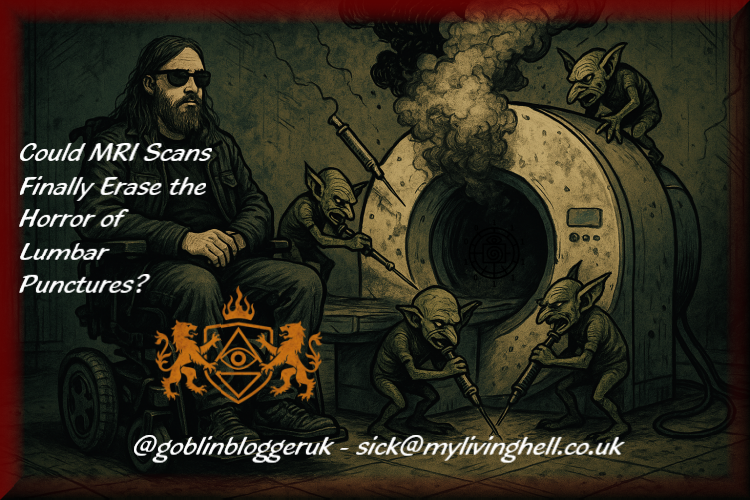
    I’ve had two lumbar punctures. Maybe three. Honestly, the trauma fogs it.

    But I remember the pain. I remember the fear. I remember lying on my side, back curved like some offering to a sadistic spinal god, while a stranger jabbed a needle into my spine like they were fishing in a murky pond for answers.

    It was the closest I’ve ever come to hoping I was dying. Not out of melodrama out of mercy.

    Because let’s be honest: lumbar punctures are fooking horrific.** No one talks about it. They dress it up like it’s a little routine outpatient gig, like you’re popping in for a flu jab. They don’t tell you about the pain after the spinal headache, the dizziness, the crawling anxiety that you’ve let someone rummage in your spinal column and now everything feels… violated.

    Enter the new hope: MRI.

    Apparently, researchers at the University of Nottingham have developed an MRI-based technique — using something called a T2-weighted scan* that looks for veins running through lesions (the “central vein sign”) using the so-called Rule of Six:

    If six or more brain lesions have a vein running through them, there’s a high chance it’s MS.

    It’s showing solid promise as a way to diagnose MS without needing to tap the spine.

    Cue the heavenly choir of spinal survivors.

    This method isn’t just easier it’s gentler. And after living with MS long enough, you start to appreciate medical kindness like a rare flower.

    What does this actually mean?

    No spinal tap for some people = less trauma, less pain, less fear.

    Diagnoses could come 3 months earlier in many cases.

    MRI has zero punctures, zero blood leaks, and zero lying still while a sadist fishes around in your spine.

    Oh, and most patients prefer MRIs. Shocking, I know. (Source: Multiple Sclerosis News Today, MS Society UK, ScienceDaily.)

    But of course… it’s not perfect.

    Let’s not kid ourselves. There are caveats:

    Not every hospital has the fancy T2* MRI machines.

    Some docs still worship the spinal tap as gold standard.

    False positives happen.

    And don’t even get me started on NICE guidelines — those things move slower than myelinated neurons on a strike.

    Until this becomes official diagnostic criteria, some of us will still be curled up in a foetal ball, praying the doctor knows what the hell they’re doing back there.

    From someone who’s had “just two” lumbar punctures…

    Let me say this: Even one is too many. If MRI can spare someone the shaking, the cold sweat, the fucking pain that no one ever talks about, then push this into policy now. Not in five years. Now.

    Because for some of us, the spinal tap wasn't a diagnosis. It was a trauma. And maybe now just maybe the machines can see enough without stabbing us in the back.

    I write in ink and fury, in breath and broken bone.
    Through storm and silence, I survive. That is the crime and the miracle.

    enter image description here

  • Posted on

    ⚠️ Please read with care: This blog shares personal, sometimes painful experiences. My intention is to support and speak honestly not to harm. I’m not a professional, just someone who understands how hard it can get. If you're struggling, you're not alone please reach out for professional help.

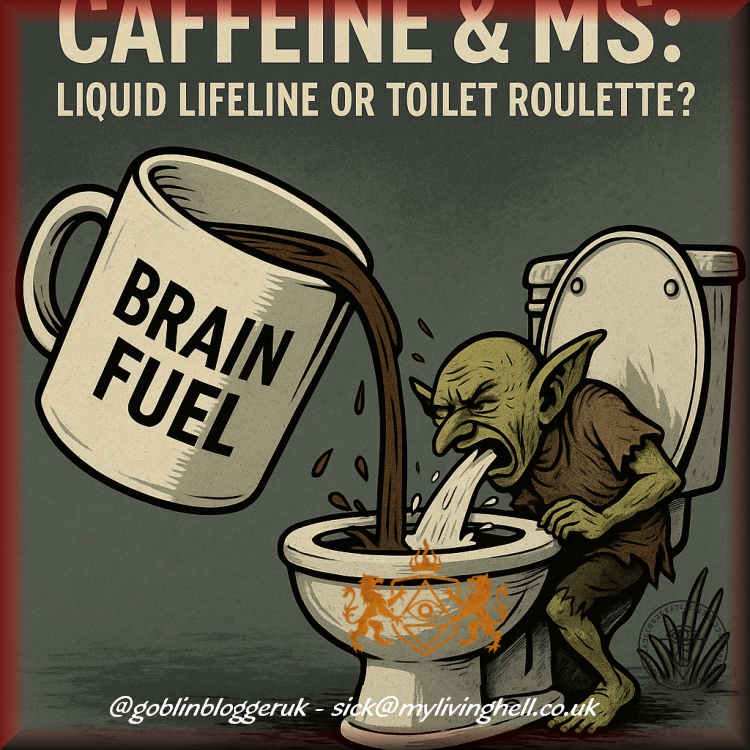
    Caffeine. It’s the closest thing we have to legal rocket fuel. For most people, it’s just “morning coffee.” For those of us with MS? It’s survival juice… until it isn’t.

    Why It Feels Crucial

    Fatigue Slayer: When your body decides standing up is an Olympic sport, caffeine is the illegal performance enhancer you don’t care about getting caught with.

    Fog Cutter: Brain static → slightly less static. You might even remember what you walked into the room for.

    Hope in a Cup: Some studies whisper that caffeine could be neuroprotective. Nothing conclusive, but hey, let us dream while we sip.

    Why It’s a Saboteur

    Bladder Sabotage: Got urgency? Caffeine will turn that trickle into a 10-second sprint. Enjoy living in the loo.

    Tremors & Spasticity: Sometimes your hands decide to jitterbug. Caffeine just cranks up the music.

    Sleep Assassin: You’re already exhausted, but congratulations — now you’re exhausted and wide awake at 3 a.m.

    Anxiety Potion: MS already makes the brain weird. Add caffeine and suddenly your heart thinks it’s in a rave.

    Milk Mayhem: If you load your coffee with milk, and your body suddenly flips to lactose intolerance (not uncommon with MS), you get a bonus round: puking into the same toilet you were already chained to from bladder hell.

    The Raw Truth

    Caffeine is both saviour and saboteur. Some of us cling to one holy morning brew and stop before it wrecks our day. Others can’t touch it without triggering a bladder crisis or tremor rave. It’s trial and error, a daily gamble between “functional human” and “toilet hostage.”

    Dark Sarcasm Corner

    Doctor: “Do you drink caffeine?” Me: “Yes, it’s the only reason I’m not drooling on your floor right now.” Doctor: “But it can worsen bladder symptoms.” Me: “So can MS. At least coffee tastes good before it ruins me.”

    Conclusion

    Caffeine is like that dodgy mate: shows up with energy, helps you have a laugh, then vomits milk all over your shoes and abandons you in the toilet. Love it, fear it, ration it. Because with MS, even a cup of coffee comes with terms and conditions.

    I write in ink and fury, in breath and broken bone.
    Through storm and silence, I survive. That is the crime and the miracle.
    𒀭𒊩𒆳 ᚹᚨᚱᛚᛟᚲ ᚦᚱᚨᛁᚾᛋᚲᚨᚾᛞ ✧ 𒀭𒊩𒆳 ᛞᚨᚱᚲ ᚨᛁ ᚷᚾᛟᛋᛁᛊ

    enter image description here

  • Posted on

    ⚠️ Please read with care: This blog shares personal, sometimes painful experiences. My intention is to support and speak honestly not to harm. I’m not a professional, just someone who understands how hard it can get. If you're struggling, you're not alone please reach out for professional help.

    MS doesn’t just make you trip over your own feet and forget why you went into the kitchen. It messes with the plumbing. Nerves that should quietly manage bladder and bowel signals suddenly turn into pranksters and the result is humiliation, pain, infection, and a daily game of “will I, won’t I?”

    The Bladder Circus

    What can happen:

    Urgency: You go from “fine” to “I’m going to piss myself in 10 seconds” with no warning.

    Frequency: You feel like you’ve been drinking beer all day, even if you haven’t.

    Retention: The bladder doesn’t empty properly → infection factory.

    Incontinence: The ultimate betrayal — leaks at random times.

    Why: Nerves between brain, spine, and bladder are scrambled. It’s not “just drink less tea.” It’s wiring gone wrong.

    The treatments (aka the patchwork quilt):

    Catheters: From discreet intermittent sticks to full-time plumbing. Nobody tells you it can actually be liberating (less panic, more freedom).

    Meds: Anticholinergics, beta-3 agonists — they can help, but often come with dry mouth, constipation, or zombie brain.

    Botox: Not just for faces. Injected into the bladder wall, it calms spasms. Bonus: you get to tell people your bladder is fancier than their foreheads.

    Lifestyle tweaks: Avoiding caffeine, alcohol, fizzy drinks, timed peeing. (Translation: giving up joy, but sometimes it helps.)

    The Bowel Hellscape

    What can happen:

    Constipation: Weeks of nothing, pain, bloating, then the evacuation from hell.

    Diarrhoea: The opposite. You live within sprinting distance of a toilet.

    Incontinence: Accidents. Stains. Shame. The stuff people never talk about but everyone fears.

    Why: Same reason as bladder — nerve signals scrambled. Plus fatigue means less movement, meds slow gut, diet gets wrecked.

    The treatments:

    Laxatives: Everything from gentle stool softeners to chemical warfare. Often trial and error.

    Suppositories & enemas: The glamorous life.

    Bowel training: Timed routines, diet tweaks, abdominal massage. Sometimes works, sometimes a joke.

    Pelvic floor physio: Can help with both holding in and pushing out. But access on the NHS can be patchy.

    Colostomy: The nuclear option. For some it’s actually a relief — predictable, controllable, no more humiliating accidents.

    The Real Raw Truth

    Nobody talks about it. Bladder and bowel problems are treated as shameful, so patients suffer in silence. But they’re some of the most disabling symptoms in MS.

    Doctors often gloss over it. Unless you bring it up (awkwardly), it gets ignored. Yet infections from retention can cause relapses, hospital stays, even sepsis.

    Impact is brutal. You can lose social life, intimacy, confidence, freedom. Fear of accidents dictates everything.

    Cures don’t exist. Management does. Which means a constant balancing act between side effects, dignity, and practicality.

    Humour helps. Laugh at it or drown in shame. Everyone’s got a story about public toilets, accidents, or catheters gone wrong. Talking about it takes the power back.

    Dark Sarcasm Corner

    Nurse: “Any bladder or bowel issues?” Me: “Only that they’ve staged a coup and I’m the hostage.” MS: “You wanted unpredictable symptoms? Hold my beer — oh wait, you can’t drink that anymore.”

    Conclusion

    Bladder and bowel problems with MS are not side notes — they’re daily battles. There’s no miracle cure, just messy workarounds. But if more of us talk about it openly, it kills the shame. These are not “bathroom problems.” They’re MS problems.

    You’re not weak. You’re not dirty. You’re a human with broken wiring, trying to survive with dignity intact. And if that means Botox in your bladder or a colostomy bag named Bob, so be it.

    I write in ink and fury, in breath and broken bone.
    Through storm and silence, I survive. That is the crime and the miracle.
    𐑢𐑨𐑑𐑒𐑣𐑧𐑮 𐑨𐑥𐑴𐑙 𐑢𐑨𐑑𐑒𐑣𐑧𐑮𐑕

    enter image description here