- Posted on
⚠️ This blog shares my personal, sometimes painful experiences with MS and mental health. My intention is to speak honestly and offer solidarity—not to harm or replace professional advice. I’m not a doctor or therapist, just someone who gets how hard it can get. If you’re struggling, you’re not alone. Please reach out to a trusted friend, support group, or professional. You deserve help and hope.⚠️
please remember I suffer with severe cognitive dysfunction, and use AI to help solve this issue so you can understand it lol
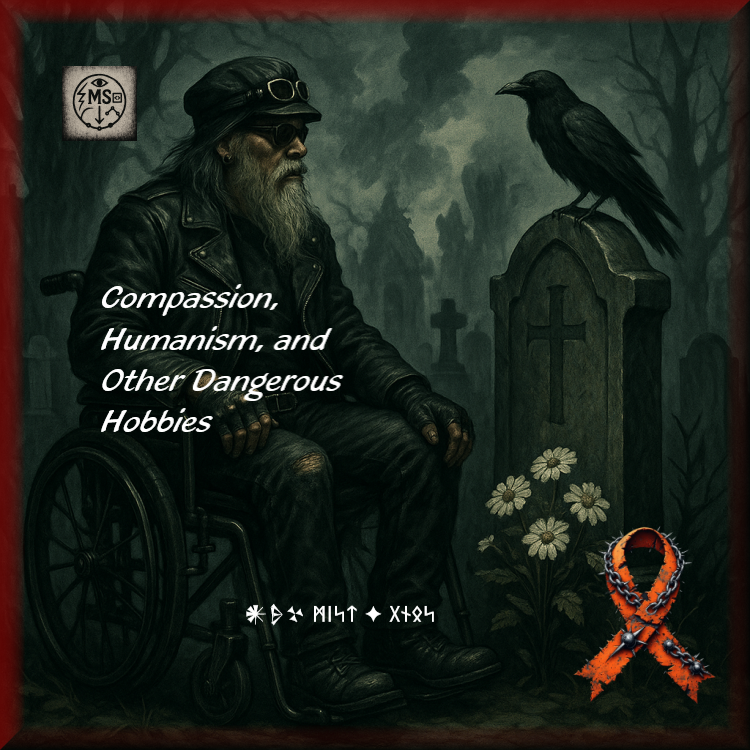
Will He Fly Again?
Multiple Sclerosis, False Hope and the Fine Art of Pretending Everything Will Be Fine
He grins, teeth chattering.
Not a cheerful grin.
Not the sort found in toothpaste adverts, family photographs or those irritating hospital leaflets where everyone appears delighted to have a chronic neurological disease.
This is the grin of someone whose body has misplaced the instruction manual.
It echoes through the hollow silence while weak lights flicker overhead, scrubbing unsuccessfully at the final stain of faith.
Second chances?
Of course.
They are probably waiting in the same cupboard as the cure, the reliable bladder and the eight uninterrupted hours of sleep.
Nobody can find the key.
When the Music Stops
A guitar plays somewhere in the darkness.
The notes arrive bent, exhausted and slightly dishonest.
False harmony for a false dawn.
He sits alone in the stillness, surrounded by the remains of everything that was supposed to happen next.
Plans.
Journeys.
Ordinary mornings.
The ability to stand up without first negotiating with several uncooperative limbs and a nervous system apparently being operated by a drunk electrician.
The silence becomes suffocating.
Every reflection is heavier than the last.
Every mirror offers a slightly different version of the same unwanted truth.
Multiple Sclerosis has moved in.
It has not paid rent.
It has rearranged the furniture, smashed several windows and now complains that the heating is inadequate.
The Delusion Department
She paints his illness in the bright colours of hope.
Not because she is foolish.
Because sometimes hope is the only paint left in the tin.
She tells herself he is strong.
He will improve.
He will adapt.
Something new will be discovered.
A treatment will work.
A specialist will finally say the words everyone is waiting to hear:
“We have fixed it.”
The specialist does not say this.
The specialist says things like:
“Disease progression.”
“Symptom management.”
“We’ll monitor the situation.”
Which is medical language for:
“We also have no bloody idea what happens next.”
Still, she clings to the images.
The wishes.
The whispered promises.
He’ll get better.
Ignore the scans.
Ignore the lesions.
Ignore the doctor’s carefully practised expression when the results appear on the screen.
Ignore the cold weight of the diagnosis.
Multiple Sclerosis.
Two words.
One lifetime rearranged.
Everyone Suffers, Apparently
There will always be someone eager to offer perspective.
“Everyone has problems.”
“Just take one day at a time.”
“Try to stay positive.”
“My neighbour’s cousin had something similar and she cured it by removing dairy.”
Wonderful.
The nervous system has been informed.
It regrets the misunderstanding and promises to remyelinate immediately.
Pain is universal, they say.
That may be true.
But some pain arrives, makes a cup of tea and leaves.
Other pain changes its address to yours, redirects its post and starts answering the telephone.
Mourning the past becomes almost impossible because the past refuses to remain politely buried.
It appears in photographs.
In old shoes.
In abandoned hobbies.
In the memory of walking without calculating every step.
Her fear begins to sing.
Not beautifully.
It sounds like old trees creaking in a winter storm.
Branches twisting.
Roots straining.
A whole forest holding its breath while something unseen decides what to take next.
Prayers and Other Failed Treatments
In time, he responds with prayers.
Some are spoken.
Some are thought.
Some are little more than exhausted bargaining directed at a ceiling that offers no comment.
Prayer is strange when illness becomes permanent.
You begin politely.
Then desperately.
Then angrily.
Eventually, you stop asking for a miracle and start asking for one tolerable afternoon.
The dread spreads slowly.
Like rot inside an apparently healthy tree.
From the outside, everything still looks solid.
The leaves remain.
The bark holds.
People walk past and say:
“You look well.”
Inside, the branches are weakening.
The muscles tremble beneath invisible storms.
Each flare exposes another fragile limb.
Another ache.
Another part of life that can no longer be trusted.
Guilt follows close behind.
The guilt of needing help.
The guilt of cancelling plans.
The guilt of being tired.
The guilt of watching someone you love become tired because you are tired.
A wonderfully efficient system.
Multiple Sclerosis attacks the body, then sends guilt along to finish the paperwork.
Waiting for Healing
The limbs listen but do not always obey.
They lie quietly beneath blankets, pretending they may cooperate tomorrow.
Sometimes they do.
Sometimes they stage a full industrial dispute without warning.
There are risks taken for the smallest hope of healing.
New medication.
Different medication.
Higher doses.
Lower doses.
More appointments.
More scans.
More leaflets featuring suspiciously cheerful people walking through sunlit fields.
Every treatment carries a possibility.
Every possibility carries side effects.
The patient becomes a laboratory with a National Insurance number.
A little less pain, perhaps.
A little more dizziness.
Fewer spasms.
More fatigue.
Better movement.
Worse sleep.
Medicine gives with one hand and occasionally clubs you over the head with the other.
Still, you try.
Because the alternative is doing nothing.
And doing nothing comes with side effects too.
The Silence That Burns
Will the disease reveal her fears?
It already has.
Her tears?
Those too.
Silence does not fade.
It burns.
It consumes the memories of a time when worries were ordinary and therefore almost luxurious.
Bills.
Work.
Traffic.
The weather.
The sort of problems one would now happily welcome back with flowers and a small buffet.
Those earlier worries have become distant dreams.
They echo beneath broken wings as he falls.
Not majestically.
Not symbolically.
Usually beside the bed while attempting to put on trousers.
There is rarely anything poetic about losing balance.
The floor does not care about metaphors.
For a while, he believes no grace is needed.
He can manage.
He can cope.
He can force the body to obey through willpower, determination and the ancient British medical practice of refusing to make a fuss.
It works magnificently.
Until it doesn’t.
Will He Fly Again?
Will he fly again?
Possibly not in the way he once did.
Will he know victory?
That depends upon what victory means.
Walking unaided?
Living without pain?
Returning to the person he was before diagnosis?
Those victories may never arrive.
That is the truth nobody enjoys printing on an inspirational mug.
There may be no full recovery.
No cinematic ending.
No miraculous final scene where he rises from the chair as the music swells and everyone applauds.
Real life is usually less considerate.
Perhaps victory is getting out of bed.
Perhaps it is laughing at the disease before it can laugh at you.
Perhaps it is writing down the darkness and making it useful.
Perhaps it is surviving another day without pretending the day was beautiful.
One tear blinds her heart as his body vibrates with uncertainty.
He is not too cowardly to face the truth.
He is simply exhausted from having to face it every morning.
There may be no recovery.
But there is still life.
Damaged, altered, infuriating life.
Life with medication boxes, mobility aids, bladder negotiations, forgotten words and bodies that behave like disgruntled civil servants.
It is not the life they ordered.
There was no receipt.
The returns department has closed.
So they remain.
Not soaring.
Not cured.
Not pretending.
Still here.
And some days, against all reasonable expectations, that is victory enough.
Warlock Dark
Chronic illness survivor, truth-teller, occasional bastard. From My Living Hell (For those who came here by accident: yes, my living hell is real. And yes, we still fight. Every shitty day. With defiance.)
☣ This Is Not A Blog About MS
This Is My Life With MS ☣