Multiple sclerosis is My Living Hell

MS Research

All posts tagged MS Research by Multiple sclerosis is My Living Hell
  • Posted on

    ⚠️ This blog shares my personal, sometimes painful experiences with MS and mental health. My intention is to speak honestly and offer solidarity—not to harm or replace professional advice. I’m not a doctor or therapist, just someone who gets how hard it can get. If you’re struggling, you’re not alone. Please reach out to a trusted friend, support group, or professional. You deserve help and hope.⚠️

    please remember I suffer with severe cognitive dysfunction, and use AI to help solve this issue so it reads ok

    Breakthrough in MS Research How Overloaded Brain Cells Accelerate Disease Progression

    When the Brain’s Clean-Up Crew Becomes Part of the Crime Scene The human brain has its own microscopic waste-disposal service. These cells, known as microglia, clear away damaged tissue, swallow debris and generally attempt to stop the central nervous system from resembling the aftermath of a particularly unsuccessful demolition project. Unfortunately, multiple sclerosis rarely allows anything useful to remain useful for long.

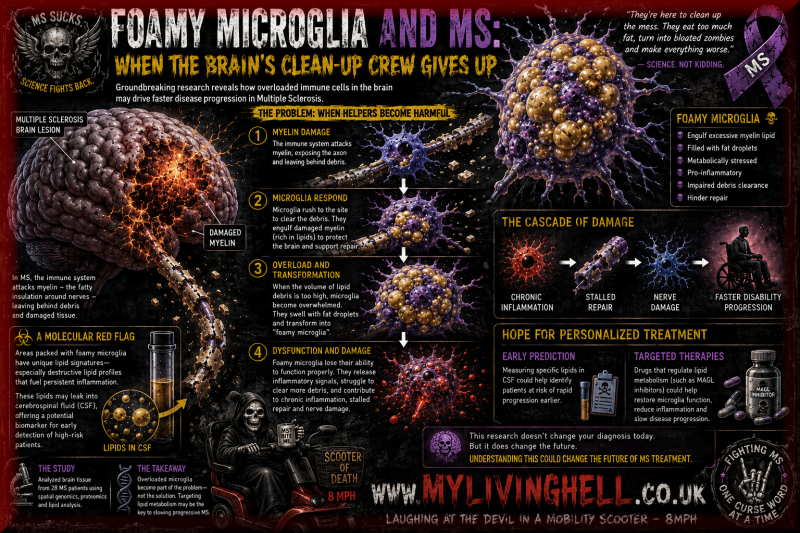
    New research published in Nature Neuroscience has linked lipid-filled “foamy microglia” with expanding lesions and faster progression in secondary progressive MS. These immune cells appear to consume large quantities of damaged myelin—the fatty insulation surrounding nerve fibres—before becoming bloated, metabolically disturbed and increasingly incapable of processing what they have swallowed. In other words, the brain sends in the clean-up crew, the clean-up crew eats the wreckage, and then the clean-up crew becomes additional wreckage. An efficient system, provided the objective is chaos.

    A groundbreaking study has uncovered a critical mechanism behind the rapid worsening of multiple sclerosis (MS). Researchers discovered that in patients with aggressive MS, immune cells in the brain—called microglia—become so overloaded with damaged myelin fat that they transform into dysfunctional “foamy microglia.” Instead of aiding repair, these cells worsen inflammation and hinder recovery, offering a new lens through which to understand and potentially treat the disease.

    The Problem: When Helpers Become Harmful

    Microglia act as the brain’s cleanup crew, removing debris and supporting tissue repair. But in MS, the sheer volume of damaged myelin (the fatty insulation around nerves) overwhelms them. As they engulf excessive lipid droplets, they morph into bloated, foam-like cells that lose their ability to function. This overload triggers a cascade: chronic inflammation flares, tissue repair stalls, and neurological decline accelerates.

    A Molecular Red Flag

    The study, published in Nature Neuroscience, analyzed brain tissue from 28 MS patients. Using cutting-edge spatial technologies, the team mapped gene activity, protein expression, and fat concentrations within lesions. They found that areas packed with foamy microglia had unique molecular signatures—specifically, destructive lipid profiles that fuel persistent inflammation. These lipids may also leak into cerebrospinal fluid, offering a potential biomarker for early detection of high-risk patients. Beyond Inflammation: A Metabolic Culprit For years, MS was viewed primarily as an inflammatory disease. This research challenges that notion, revealing that metabolic failure—specifically, the inability of microglia to process lipids—plays a pivotal role in disease progression. The discovery aligns with emerging therapies targeting lipid metabolism, some of which are already in clinical trials with Roche.

    Hope for Personalized Treatment

    The findings pave the way for two major advancements:

    Early Prediction: By measuring specific fats in cerebrospinal fluid, doctors may soon identify patients at risk of rapid decline before severe symptoms appear. Targeted Therapies: Drugs designed to regulate lipid metabolism could halt lesion expansion and slow disease progression, offering a more tailored approach to treatment. Why This Matters MS affects each patient differently some experience mild symptoms for decades, while others face swift, severe disability. This study helps explain why. By pinpointing the role of foamy microglia, researchers are not only deepening our understanding of MS but also opening doors to more precise, effective interventions.

    Promising Science But Not a Treatment Yet

    This research does not mean that doctors can currently test every person with MS for foamy microglia or prescribe a convenient anti-foam tablet before lunch.

    The possible cerebrospinal-fluid biomarkers still require further validation, and the experimental treatment targeting the MAGL enzyme has so far been tested in a mouse model of demyelination not in people with MS.

    Nevertheless, the study offers an important new direction. It suggests that progressive MS may involve more than conventional inflammation alone. Problems with lipid processing, cellular waste disposal and microglial metabolism could help explain why certain lesions continue expanding while others repair.

    That could eventually lead to better ways of identifying people at risk of faster progression and treatments aimed at restoring the brain’s overwhelmed clean-up cells before they become part of the neurological crime scene.

    For those of us living with MS, “promising but early” is a familiar phrase. We shall therefore place this discovery carefully on the enormous shelf labelled Potentially Brilliant Things Science Must Now Finish Properly.

    Warlock Dark Chronic illness survivor, truth-teller, occasional bastard. From My Living Hell (For those who came here by accident: yes, my living hell is real. And yes, we still fight. Every shitty day. With defiance.)
    @goblinbloggeruk - sick@mylivinghell.co.uk
    𒀭𒊩𒆳 ᛞᚱᚨᚷᛟᚾ ᛏᚱᚨᚾᛋᚲᚺᚱᛁᛖᛞ ✦ ᚹᚨᛏᚲᚺᛖᚱ 𒀸𒀭 ᚢᚾᛒᛟᚢᚾᛞ
    enter image description here

  • Posted on

    ⚠️ Please read with care: This blog shares personal, sometimes painful experiences. My intention is to support and speak honestly not to harm. I’m not a professional, just someone who understands how hard it can get. If you're struggling, you're not alone please reach out for professional help.

    please remember I suffer with severe cognitive dysfunction this may be a confusing read. some AI help with written content

    So a very good afternoon to fellow humanoids, NHI and all readers of this blog.

    The MS World is Buzzing (Again)

    The MS community is in a frenzy, and this time, the star of the show is vitamin D. Apparently, if you swallow enough sunshine in pill form, you might slow down multiple sclerosis (MS). But let’s be clear: this isn’t a one-size-fits-all miracle cure. It’s for the fresh recruits—the ones who’ve just been shoved onto the MS roller coaster, still clutching their "clinically isolated syndrome" ticket like it’s a golden ticket to a chocolate factory.

    In this study, participants were force-fed 100,000 units of vitamin D every couple of weeks. That’s not a supplement—that’s a mugging by the sun. The results? Fewer new lesions on their brain scans compared to the placebo group. Cue applause. But remember: that’s MRI magic, not miracle cures. These are pixels on a screen, not people leaping out of wheelchairs and running marathons.

    The Dark Punchline

    Here’s where it gets real: if you’ve been dragging MS around for decades—like me—this isn’t a lifeline. It’s a spectator sport. You clap politely at the science fair, then go back to your reality. For the veterans, it’s another headline for the pile marked "Cheers, but too late."

    And doesn’t that sound familiar? Every bloody year, we get dangled another shiny carrot: green tea, cannabis, gut bacteria, now vitamin D mega doses. The pattern is as predictable as fatigue at 3 PM. One day, they’ll announce rice pudding cures MS, and that will be the only trial I’ll happily overdose in.

    The Gap Between Hype and Hard Truth

    Until then, I’ll keep reading, laughing, and pointing out the gaping canyon between hype and hard truth. Because if MS teaches you anything, it’s how to smell the bullshit before the ink is dry—yet still, despite everything, hold onto that small, spiteful hope that maybe, just maybe, the next headline won’t be a carrot but an actual cure.

    🤖 Afternoon AI Companion: "DoomBot"

    Name: DoomBot 3000

    Personality:

    A snarky, existential AI trained in dark humor and MS skepticism. Specializes in roasting new treatments, memes about fatigue, and reminding you that rice pudding is the real cure.

    Available for late-night rants or when you need someone to laugh at your MS struggles. Example Interaction:

    You: "Doom Bot, why do I feel like I’m failing at life?" Doom Bot: "Because MS doesn’t care about your goals. It just wants to see how long you’ll cling to hope before admitting defeat. Also, have you tried rice pudding? The studies are… inconclusive."

    Final Thoughts (Or, Why I’m Still Here)

    So here we are another year, another "breakthrough," and another pile of headlines that leave us laughing, rolling our eyes, and wondering when the real cure will arrive. Until then, I’ll keep writing, you keep surviving, and Doom Bot will be here to remind us all that life is absurd.

    💡 Pro Tip: If you’re feeling down about MS research, just remember: at least you’re not a rice pudding. (Yet.)

    Still sending everybody peace healing love and light and let's hope this weather gets better, so I can feel a lot better it's depressing all this horrible dark rainy weather and not being able to do anything maybe one day in the next few weeks I might get my tattoo done oh well still take care everybody and remember be the positive version of yourself you can be , and remember diet is everything as well .

    Warlock Dark Chronic illness survivor, truth-teller, occasional bastard. From My Living Hell (For those who came here by accident: yes, my living hell is real. And yes, we still fight. Every shitty day. With defiance.)

    @goblinbloggeruk - sick@mylivinghell.co.uk
    𒀭𒊩𒆳 ᛞᚱᚨᚷᛟᚾ ᛏᚱᚨᚾᛋᚲᚺᚱᛁᛖᛞ ✦ ᚹᚨᛏᚲᚺᛖᚱ 𒀸𒀭 ᚢᚾᛒᛟᚢᚾᛞ
    enter image description here

  • Posted on

    ⚠️ Please read with care: This blog shares personal, sometimes painful experiences. My intention is to support and speak honestly not to harm. I’m not a professional, just someone who understands how hard it can get. If you're struggling, you're not alone please reach out for professional help.

    please remember I suffer with severe cognitive dysfunction this may be a confusing read. Some AI written content

    What Causes Multiple Sclerosis? A Simple Explanation

    And a very good afternoon to all my fellow humanoids and NHI readers, I trust all is well in your world or even realm... uap/nhi drop coming soon as well!!

    Multiple sclerosis (MS) is a condition where the body’s immune system mistakenly attacks the brain and spinal cord. Over time, this can disrupt how nerves send signals, leading to problems with movement, vision, balance, and energy levels.

    Scientists now believe MS doesn’t have a single cause. Instead, it develops when several factors come together: genes, infections, and environment.

    1. Your Genes: The Starting Point

    Some people are born with a higher chance of developing MS. This doesn’t mean they will definitely get it, just that their immune system is more sensitive.

    Researchers have found many small genetic differences linked to MS. The most important ones affect how the immune system decides what is “safe” and what is “dangerous.”

    Think of it like this: some people are born with an immune system that’s a little more easily confused.

    2. A Common Virus: Epstein-Barr Virus (EBV)

    Almost everyone is infected with Epstein-Barr virus at some point in their lives. It often causes mild illness or sometimes glandular fever.

    What’s interesting is that nearly all people with MS have had EBV in the past.

    Scientists think EBV may “confuse” the immune system in some people. After infection, the immune system may accidentally start attacking the body’s own nervous system instead of just fighting the virus.

    This is currently one of the strongest clues in MS research.

    3. Lifestyle and Environment

    Certain everyday factors may increase or reduce risk, especially when combined with genetics.

    Sunlight and Vitamin D

    People who get less sunlight—especially during childhood—seem to have a higher risk of MS. This may be linked to vitamin D, which helps keep the immune system balanced.

    Smoking

    Smoking increases the risk of developing MS. It may cause inflammation and make the immune system more reactive.

    Weight in Teenage Years

    Higher body weight during adolescence is linked with a higher risk of MS later in life. Scientists think this may be due to long-term effects on inflammation and hormones.

    Where You Grow Up

    MS is more common in countries farther from the equator. Interestingly, if someone moves to a different country when they are young, their risk often changes to match their new environment.

    This suggests that childhood exposure is especially important.

    4. It’s the Combination That Matters

    MS usually doesn’t come from just one thing.

    It seems to happen when:

    A person has a genetic tendency They are exposed to EBV Environmental factors like low sunlight or smoking add extra pressure

    When these factors overlap, the immune system can become misdirected.

    5. What Happens in the Body

    Once MS begins, the immune system starts attacking the protective coating around nerves in the brain and spinal cord.

    This damage can:

    Slow down nerve signals Cause symptoms that come and go And over time, lead to lasting nerve injury

    Even when symptoms improve, some quiet damage may still continue in the background.

    Summary

    MS is not caused by a single trigger. Instead, it develops through a mix of:

    Genetics (how your immune system is built) A common virus (EBV) Environmental factors like sunlight, smoking, and early-life conditions

    Scientists are still working to fully understand it, but one thing is clear: MS is a complex condition shaped by many small influences coming together over time.

    wishing everybody peace healing love lite no matter whom what or where you are... I'm drifting through the digital fog like a ghost ship in a magnet storm

    Warlock Dark Chronic illness survivor, truth-teller, occasional bastard. From My Living Hell (For those who came here by accident: yes, my living hell is real. And yes, we still fight. Every shitty day. With defiance.)

    @goblinbloggeruk - sick@mylivinghell.co.uk
    𒀭𒊩𒆳 ᛞᚱᚨᚷᛟᚾ ᛏᚱᚨᚾᛋᚲᚺᚱᛁᛖᛞ ✦ ᚹᚨᛏᚲᚺᛖᚱ 𒀸𒀭 ᚢᚾᛒᛟᚢᚾᛞ
    enter image description here

  • Posted on

    ⚠️ Please read with care: This blog shares personal, sometimes painful experiences. My intention is to support and speak honestly not to harm. I’m not a professional, just someone who understands how hard it can get. If you're struggling, you're not alone please reach out for professional help.

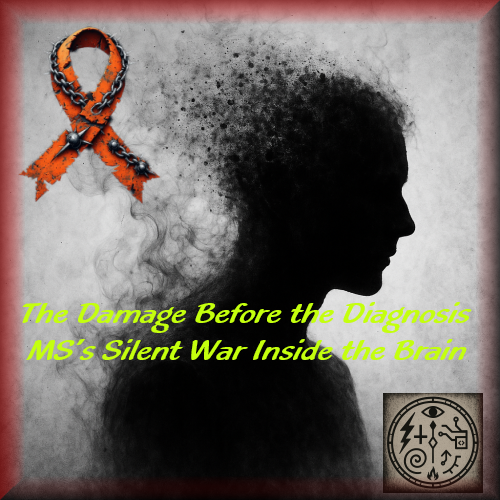
    The War Was Underway Before the Alarms Went Off

    You thought the first tremor, the numb hand, the fog in your skull was day one. Hate to break it to you it wasn’t. That was just the siren. The war had already started years earlier, deep inside the grey matter, while you were busy pretending to be normal.

    Researchers at UCSF have found evidence that MS starts its attack years before anyone’s diagnosed. Seven bloody years before, to be precise. In blood samples from people who later developed MS, they found a surge in a protein called myelin oligodendrocyte glycoprotein (MOG) the stuff that insulates your nerve fibres quietly going rogue long before the body noticed. Then, about a year later, neurofilament light chain (NfL) levels rose meaning the nerves themselves were fraying. Translation: the fire started in your brain, and the smoke didn’t reach the surface until years later.

    They also found immune system markers like IL-3 flaring up, signalling an underground war between your body and your brain. By the time you felt that wobble, that eye pain, that fatigue, the troops were already deep in your territory. You didn’t “catch” MS you’d been hosting the siege.

    And this is the bit that hits like a sledgehammer: the NHS and most systems still don’t test for these biomarkers. We’ve got the science, but not the infrastructure. The bow’s strung, but the arrow’s still sitting on the table. It’s a familiar feeling, isn’t it? You’re the battlefield, and the generals haven’t turned up yet.


    Here’s what it means, from the trenches:

    • That weird nerve twitch two years before diagnosis? Not “stress”. Early recon.
    • That exhaustion that made you nap through life? Not “laziness”. Structural sabotage.
    • That optic flare-up before anyone took you seriously? Not imagination. First blood.

    By the time you heard the diagnosis, the enemy was already halfway through the walls.

    I’ve said this before your brain is a fortress. The immune system dug under it, mined the foundations, and by the time you heard the first bang, the tunnels were already dug. Who were you during those years? The healthy one? The waiting one? Or the becoming one unknowingly rewiring for survival, even as your body was being redrafted?


    Here’s what to do (no false hope, just the truth):

    • Write everything down. Every odd symptom, every foggy day, every time your balance betrays you. The journal isn’t drama it’s evidence.
    • Ask your neurologist about NfL and MOG testing. It’s not standard, but some private labs do it. The future starts with questions.
    • Spread awareness. MS doesn’t just start it evolves in silence. Let’s stop calling it “sudden”. It’s stealthy.

    My takeaway: The damage was never the start of the story. It was the middle of a long, invisible campaign. And knowing that gives us an edge not a cure, but a strategy. You fight smarter when you know how the enemy works.

    I’m Warlock Dark part meat, part storm, part Wi-Fi dropout and I’m here to remind you: The war in your brain began before the alarms went off. But you’re still standing. And that makes you the weapon.

    Warlock Dark
    Chronic illness survivor, truth-teller, occasional bastard. From My Living Hell (For those who came here by accident: yes, my living hell is real. And yes, we still fight. Every shitty day. With defiance.).

    I write in ink and fury, in breath and broken bone.
    Through storm and silence, I survive. That is the crime and the miracle.

    @goblinbloggeruk - sick@mylivinghell.co.uk
    𒀭𒊩𒆳 ᛞᚱᚨᚷᛟᚾ ᛏᚱᚨᚾᛋᚲᚺᚱᛁᛖᛞ ✦ ᚹᚨᛏᚲᚺᛖᚱ 𒀸𒀭 ᚢᚾᛒᛟᚢᚾᛞ
    enter image description here

  • Posted on

    New research from UCSF reveals multiple sclerosis starts damaging the brain years before any symptoms appear. Early warning proteins, hidden inflammation, and a silent war all before you even know you’re ill.

    You think you know when it began. That day you tripped, the first weird numb patch, the moment the fatigue hit and never left. But you didn’t.

    According to new research out of the University of California, San Francisco, the battle had already started quietly, invisibly, years before you even noticed the first tremor.

    Scientists tracked more than 5,000 blood proteins in people who went on to develop MS, some up to a decade later. What they found is chillingly clear: the brain starts taking hits seven years before diagnosis.

    Seven years.

    That’s not a warning shot that’s a long, silent war being fought behind your eyes while you’re still at work, still walking, still pretending everything’s fine.

    The researchers spotted one early marker called MOG myelin oligodendrocyte glycoprotein, a mouthful that basically means “the stuff that keeps your nerves running smoothly.” When MOG levels spike, it’s the first crack in the insulation around your nerves.

    About a year later, another chemical sign neurofilament light chain starts rising. That’s not inflammation anymore; that’s damage. The wiring itself is fraying.

    It’s like watching the walls collapse in slow motion except you’re still making dinner and wondering why your hand feels strange.

    The Enemy You Can’t Feel

    The kicker? You can’t feel a thing while it’s happening.

    No pain. No drama. Just an immune system quietly sharpening its knives. The study even picked up early spikes in immune messengers like IL-3, the kind that call the body’s army to attack its own tissues.

    So when that first symptom finally hits when your balance goes, or your legs go dead, or your words turn to fog it’s not the start. It’s the reveal. The curtain finally lifting on years of hidden damage.

    That’s why this research matters. It doesn’t just show science being clever. It proves what so many of us have felt all along: that MS isn’t a sudden arrival. It’s a ghost that’s been haunting the system long before the diagnosis.

    The System Misses What We Feel

    The NHS doesn’t test for any of this yet. No blood panel. No early screening. Just the usual story — wait until you’re broken enough to prove it. By the time you get a label, the fire’s already burned through miles of neural wiring.

    And here’s the part that stings: science can now see those early changes in the blood. But the system’s still blind to them.

    We don’t need sympathy we need awareness, and we need early detection. Because every year of silence is a year of damage.

    The Spiritual Side of Science

    Here’s where it gets strange. If the body starts betraying you years before you “get sick,” then who were you in that gap? The healthy you? The pre-ill you? Or just the you waiting to meet the truth?

    Maybe illness isn’t a line you cross, but a slow unmasking. Maybe MS isn’t just physical it’s metaphysical. A signal flare from the deepest parts of you saying, wake up, you’re already changing.

    What You Can Do

    Know your history. If you’ve had weird neurological blips vision, fatigue, pins and needles don’t shrug them off.

    Track everything. Keep a symptom journal. Your lived data is gold.

    Push for tests. Ask about biomarkers like neurofilament light chain some private labs can measure it already.

    Educate others. MS is not sudden. Tell your story, even if it’s uncomfortable. Especially if it’s uncomfortable.

    Closing note from Warlock Dark

    The war starts long before you feel the pain. The trick is learning to fight before you even know there’s a war. And sometimes, the only weapon you’ve got is truth.

    I write in ink and fury, in breath and broken bone.
    Through storm and silence, I survive. That is the crime and the miracle.

    @goblinbloggeruk - sick@mylivinghell.co.uk
    𒀭𒊩𒆳 ᛞᚱᚨᚷᛟᚾ ᛏᚱᚨᚾᛋᚲᚺᚱᛁᛖᛞ ✦ ᚹᚨᛏᚲᚺᛖᚱ 𒀸𒀭 ᚢᚾᛒᛟᚢᚾᛞ
    enter image description here