
Multiple sclerosis is My Living Hell

Clinically Isolated Syndrome

All posts tagged Clinically Isolated Syndrome by Multiple sclerosis is My Living Hell
  • Posted on

    ⚠️ Please read with care: This blog shares personal, sometimes painful experiences. My intention is to support and speak honestly not to harm. I’m not a professional, just someone who understands how hard it can get. If you're struggling, you're not alone please reach out for professional help.

    The Many Faces of MS: Four Shades of the Same Beast

    Doctors love tidy categories. It makes their conferences neater and their PowerPoints prettier. They say there are four main types of MS: CIS, RRMS, SPMS, PPMS. Add a few rarities for spice malignant, benign, radiological-only and voilà: a zoo of acronyms.

    But here’s the truth: those tidy boxes don’t mean a damn thing when you’re living it. MS doesn’t give a toss about your labels. It just chews through nerves at its own pace while you try to hang on with your fingernails.

    My Version of the Four Types

    The Intruder Phase

    The first knock at the door. A rogue signal. Something’s off, but you don’t yet know the squatters have moved in. Fear mixed with disbelief, like waiting for a verdict you already know is guilty.

    The Checkerboard War

    Flare, heal, flare, heal. A sick game of snakes and ladders, only the dice are loaded. You learn strategy: rest, attack, regroup. But the house always wins in the end.

    The Slow Burn

    Relapses fade, but the damage doesn’t. Inch by inch, it eats. You don’t need a flashy MRI to prove it you can feel the slow rot in your bones, your mind, your will. This is SPMS: the bastard’s long game.

    The Quiet Conquest

    For some, there’s no drama, no storms, no sudden drops. Just a slow, relentless tightening of the vice. That’s PPMS: the quiet predator. It doesn’t roar, it whispers while it strangles.

    And then there are the ghost forms: so-called benign (which feels like a cruel joke) or the malignant that slams into you like a train.

    What These Labels Hide

    • Flux & Overlap: The lines aren’t walls. You slide, bleed, convert. Boxes aren’t boundaries, just suggestions.
    • Emotional Punch: Being told “you have PPMS” is like being handed a death sentence dressed up in medical Latin.
    • The System’s Lens: These labels exist for trials, drugs, and insurance companies. They don’t guide your daily grind.
    • Your Identity: To outsiders, you become the acronym. But you are not “SPMS.” You are a person dragging a monster.

    My Hope, My Roar

    These categories might help doctors, but they don’t define us. If MS insists on giving me a label, I’ll twist it into something else. I’ll call it by my words: intruder, war, burn, conquest.

    Because at the end of the day, there isn’t four MSes. There’s one beast, swapping masks. Today it’s relapse and remission, tomorrow it’s slow suffocation. Same predator, different costume.

    So when the next shiny study lands new drug, new vitamin, new miracle—I check the fine print. Who are they studying? “Active MS”? “Early RRMS”? The rest of us watch from the side-lines, left holding the bill.

    I roar because I’ve been there. I’ve seen the trenches. I’ve lived beyond the tidy labels. And if MS dares to name me, I’ll name it back with rage, with metaphor, with gallows humour.

    Afternoon AI Thought: MS has “four types,” they say. I say it’s one predator with a wardrobe problem today a wolf, tomorrow a vulture, always the same teeth.

    I write in ink and fury, in breath and broken bone.
    Through storm and silence, I survive. That is the crime and the miracle.

    𒀭𒊩𒆳 ᚹᚨᚱᛚᛟᚲ ᛞᚨᚱᚲ ✦ 𒀭𒊩𒆳 ᚹᚨᛏᚲᚺᛖᚱ ᚨᛗᛟᚾᚷ ᚹᚨᛏᚲᚺᛖᚱᛋ
    enter image description here

  • Posted on

    ⚠️ Please read with care: This blog shares personal, sometimes painful experiences. My intention is to support and speak honestly not to harm. I’m not a professional, just someone who understands how hard it can get. If you're struggling, you're not alone please reach out for professional help.

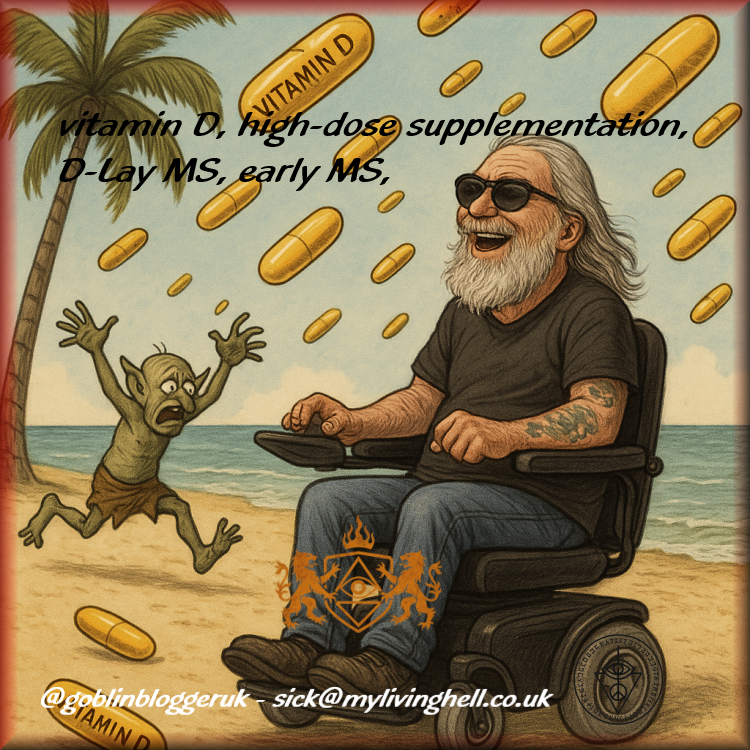
    Vitamin D has always been the vitamin of “maybe helpful, probably harmless.” If you live in the UK and know rain better than sun, you’ve probably popped a tiny supplement every winter while half your bones creak. Recently, the D-Lay MS trial dropped. And what it suggests is: maybe we’ve been too timid.

    303 people with Clinically Isolated Syndrome (CIS) who had low vitamin D were split into two groups. One got 100,000 IU vitamin D every two weeks for 2 years. The other got a placebo (because science is cruel). After 24 months:

    • Those on vitamin D had a 34% lower chance of new lesions or relapses.
    • Time to first new MRI change/relapse doubled (432 vs 224 days).
    • MRI scans showed fewer abnormalities in the vitamin D group.
    • Serious side effects? Pretty similar to placebo. Nothing obviously wild.

    Sounds good. But: this was early MS / CIS. Might not help someone whose disease is long-standing or whose body is already ravaged. And 100,000 IU every two weeks is way above what the NHS currently recommends for supplementation. Also, still not tested as a replacement for disease-modifying therapy — more like a sidekick.

    Mechanism of Action

    Vitamin D is thought to influence immune function, potentially modulating the inflammatory processes that contribute to MS progression. This could explain why higher levels might be beneficial for those with CIS.

    Current NHS Guidelines

    The NHS currently recommends a daily intake of 10 micrograms (400 IU) of vitamin D for most adults, which is significantly lower than the doses used in the D-Lay trial. This discrepancy highlights the need for further discussion with healthcare providers.

    Long-term Effects

    While the trial showed promising short-term results, more research is needed to understand the long-term effects of high-dose vitamin D supplementation on MS progression and overall health.

    Patient Experiences

    Anecdotal evidence from patients who have tried high-dose vitamin D suggests varying experiences. Some report improvements in symptoms, while others see little change. Personal stories can provide valuable insights into the potential benefits and limitations of this approach.

    Future Research Directions

    Ongoing studies are exploring the role of vitamin D in MS and other neurological conditions. These future investigations may provide more definitive answers regarding optimal dosing and long-term safety.

    Dietary Sources of Vitamin D

    In addition to supplementation, dietary sources of vitamin D include fatty fish (like salmon and mackerel), fortified foods (such as cereals and dairy products), and egg yolks. Incorporating these foods can help boost vitamin D levels naturally.

    Lifestyle Factors

    Lifestyle factors, such as sun exposure and diet, significantly influence vitamin D levels. Engaging in outdoor activities during sunny months can help increase natural vitamin D synthesis in the skin.

    Consultation with Specialists

    It’s crucial to consult with specialists, such as neurologists or endocrinologists, for personalized advice on vitamin D supplementation and MS management. They can provide tailored recommendations based on individual health needs.

    So here’s the “what you might do if you were scrappy and tired of waiting”:

    • Ask your neurologist about testing your vitamin D levels, especially if they’re low.
    • If you’re in early MS or CIS, and deficient, ask whether high-dose vitamin D (with proper monitoring) might be an option.
    • Don’t assume that more is always better — risks still exist (hypercalcaemia, kidney issues, etc.).
    • Keep using your DMTs and other treatments. This looks like a companion, not a cure.

    Dark Sarcasm Moment: We’ve spent decades being told low vitamin D might increase MS risk, yet when trials run, “no effect.” Now suddenly, dosage + timing = possibly useful. Took long enough.

    This revised summary provides a comprehensive overview of the D-Lay MS trial and its implications, while also offering practical advice and additional context for readers.

    I write in ink and fury, in breath and broken bone.
    Through storm and silence, I survive. That is the crime and the miracle.
    𒀭𒊩𒆳 ᚹᚨᚱᛚᛟᚲ ᛞᚨᚱᚲ ✦ 𒀭𒊩𒆳 ᚹᚨᛏᚲᚺᛖᚱ ᚨᛗᛟᚾᚷ ᚹᚨᛏᚲᚺᛖᚱᛋ
    enter image description here